


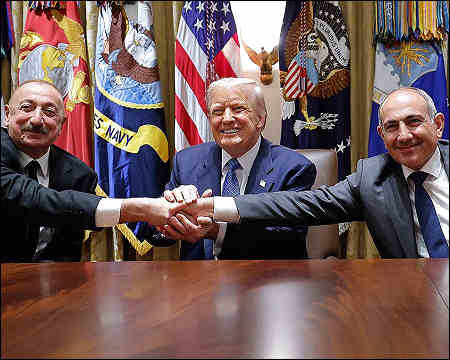
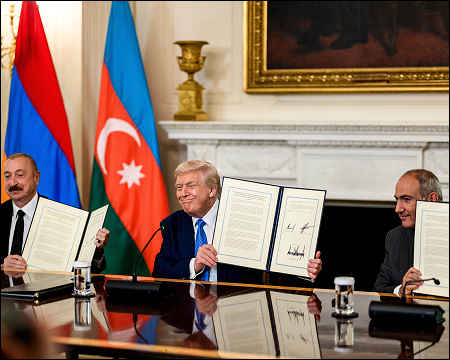
WASHINGTON,— Azerbaijan and Armenia signed a U.S.-brokered agreement on Friday aimed at restoring peace and expanding economic cooperation after decades of hostility, in a move facilitated by President Donald Trump.
The pact, finalized at the White House, seeks to normalize relations between the two South Caucasus neighbors and could reshape regional dynamics long dominated by Russian influence.
“This is a historic moment after 35 years of conflict,” Trump said during the signing ceremony, flanked by Azerbaijani President Ilham Aliyev and Armenian Prime Minister Nikol Pashinyan. “They are going to be friends for a long time.”
The roots of the dispute trace back to the late 1980s when Nagorno-Karabakh, a mountainous territory inside Azerbaijan but primarily populated by ethnic Armenians, declared independence with Armenia’s backing.
After years of intermittent fighting, Azerbaijan regained full control over the region in 2023, leading to the displacement of nearly 100,000 ethnic Armenians, who fled to Armenia.
Under the new agreement, the two nations have pledged to halt hostilities, establish diplomatic ties, and respect each other’s sovereignty.
The deal also grants the United States exclusive development rights to a key transit corridor passing through the South Caucasus, which officials say will enhance exports of energy and other resources.
Trump also announced separate bilateral agreements with Azerbaijan and Armenia to deepen cooperation in energy, trade, and technology sectors, including artificial intelligence. Specific details were not disclosed.
Additionally, restrictions on U.S.-Azerbaijan defense cooperation were lifted, a move that could heighten Moscow’s concerns about growing American influence in the region.
Both Aliyev and Pashinyan publicly thanked Trump for his role in facilitating the peace deal and said they would nominate him for the Nobel Peace Prize.
The Trump administration has emphasized its global peacemaking efforts during the early months of his second term, citing previous successes such as ceasefire facilitation between Cambodia and Thailand, peace talks between Rwanda and the Democratic Republic of the Congo, and attempts to ease tensions between Pakistan and India.
However, it has not yet resolved ongoing conflicts like the war in Ukraine or the Israel-Hamas violence in Gaza. Trump said he plans to meet Russian President Vladimir Putin in Alaska on August 15 to discuss the Ukraine war.
U.S. officials involved in the negotiations said the agreement was the result of multiple visits and discussions in the region and forms a foundation for eventual full normalization of ties.
The South Caucasus region, bordering Russia, Turkey, Iran, and Europe, is strategically important for its energy pipelines but has long suffered from closed borders and ethnic conflicts. Analysts say the agreement could help Western efforts to counter Russian sanctions evasion.
Brett Erickson, a sanctions advisor at Loyola University Chicago, said the peace deal “opens a pathway for the West to engage Armenia and Azerbaijan more effectively and cut off sanctions evasion routes.”
Tina Dolbaia, a fellow at the Center for Strategic and International Studies, noted the deal’s symbolic significance but cautioned that key questions remain, including which U.S. firms would operate the transit corridor and the level of cooperation from both countries on its construction.
She predicted Moscow would be displeased by its exclusion from the pact and U.S. involvement in the corridor. “For Russia, seeing Armenians and Azerbaijanis shake hands and accept U.S. roles in the region is a major shift,” she said.
Regional expert Olesya Vartanyan described the agreement as bringing “greater predictability” but warned that Armenia and Azerbaijan’s history of failed talks means sustained U.S. involvement will be critical to prevent renewed tensions.
U.S. officials said the deal represents the resolution of the first of several frozen conflicts near Russia’s borders since the Cold War’s end, signaling a broader regional shift.
According to sources, Armenia will grant the U.S. exclusive development rights to the transit corridor for an extended period. The so-called Trump Route for International Peace and Prosperity has attracted interest from nine companies, including three based in the U.S.
Meanwhile, human rights activists urged the Trump administration to press Azerbaijan to release around 375 political prisoners held in the country.
Azerbaijan, a major oil producer and last year’s host of the United Nations climate summit, has rejected Western criticism of its human rights record as interference in its internal affairs.
(With files from Reuters)
Copyright © 2025 iKurd.net. All rights reserved
Related posts:
 The Resurrection (Ba’ath) Party – Before the Iran-Iraq War
 Trump’s political games and Kurdish paths to autonomy in Rojava
 Israel Betrayed Armenians. Will It Betray Syrian Kurds Now Too?
 Iraqi Kurdistan – “Sold Out!” – Part II
 Saddam Hussein was a Friend to the West
 Business with ISIS – Updated
 The Teflon President Donald J. Trump
 It’s Nagorno-Karabakh All Over Again in Syrian Kurdistan
 American Democracy is on Trial!
 Behind the Veil of Turkey’s ‘Zero Problem’ Policy – A Kurdish Perspective