

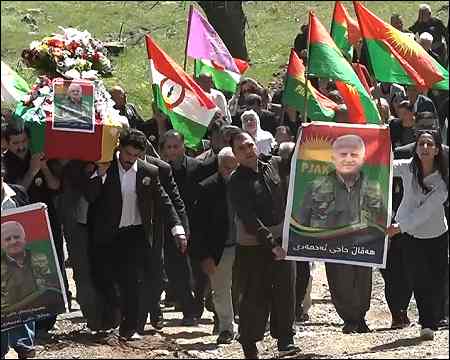
QANDIL,— The body of Abdul Rahman Haji Ahmadi, former co-leader of the Iranian Kurdistan Free Life Party (PJAK), was buried on Sunday in the Martyrs’ Cemetery in the Qandil Mountains in Iraq’s Kurdistan region (Bashur). His burial followed his personal request to be laid to rest among fellow Kurdish fighters, Rojnews reported.
After living a simple life in Germany, where he passed away on March 18, 2025, his body was returned to Iraqi Kurdistan for burial.
The funeral was attended by party officials, family members, and supporters. A moment of silence was observed before mourners chanted the phrase, “Martyrs never die,” a common slogan in Kurdish nationalist movements.
Siamand Muini, current co-chair of PJAK, praised Haji Ahmadi’s life-long dedication to Kurdish independence.
“Haji Ahmadi committed his life to the cause of his people,” Muini said during the ceremony. “He remained steadfast until his final days and has now been buried where generations of Kurdish fighters rest.”
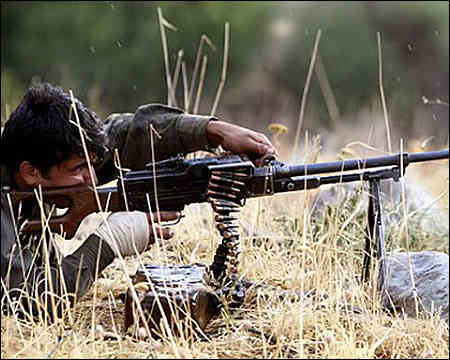
PJAK (Partiya Jiyana Azad a Kurdistane), which has operated in the mountainous border areas between Iranian Kurdistan and Iraqi Kurdistan since 2004, is an armed Kurdish nationalist group. It seeks increased autonomy for Kurds in Iran, where Kurdish regions are often referred to as Rojhelat, or Eastern Kurdistan.
The group is known to have several thousand fighters, half the members of PJAK are women. It is a member of the Kurdistan Communities Union (Koma Civaken Kurdistan or KCK), which is an alliance of Kurdish groups and divisions led by an elected Executive Council.
The KCK, a political umbrella organization that includes the Kurdistan Workers’ Party (PKK), which has long campaigned for Kurdish rights in Turkey Kurdistan (Bakur).
Speeches during the funeral focused on Haji Ahmadi’s political legacy and the broader Kurdish struggle. Kara Muhammad, representing the Kurdish women’s movement, described him as “a patriot who gave his life for the future of Kurdistan.”
Another statement read during the service, from Lanja Khurshid on behalf of Ahmadi’s family, urged visitors to Qandil to pay respects to the Martyrs’ Cemetery and “honor those who gave their lives in the mountains.”
“In Qandil, where Haji wished to be buried, the sun of Kurdish freedom continues to rise,” she said.
Haji Ahmadi was known for advocating women’s rights within the Kurdish movement. According to statements made at the service, he requested that his struggle be continued especially in support of Kurdish women and the ideas of PKK leader Abdullah Ocalan.
Shoresh Gul, a family member, told attendees that Ahmadi’s stance against occupation and political suppression remained unwavering throughout his life. “We consider his legacy a national asset that we must protect,” Gul said.
Sherko Hama Amin, speaking on behalf of the Kurdistan National Congress, noted that Ahmadi supported the “Women, Life, Freedom” movement in Eastern Kurdistan. He emphasized that Ahmadi’s resistance extended beyond partisan lines and represented a wider Kurdish identity.
The plight of Kurds in Iran has been marked by longstanding challenges, particularly since the 1979 Islamic Revolution.
Kurds in Iranian Kurdistan have faced widespread discrimination in various social, economic, and political sectors. They have been denied access to basic cultural rights, including the right to name their children with Kurdish names, which has been banned by authorities.
Additionally, religious minorities, many of whom are Kurdish, have been subjected to harsh measures aimed at isolating and stigmatizing them.
Kurds in Iran have also faced discrimination in employment opportunities, housing, and political participation, leading to entrenched poverty and marginalization within the country.
Estimates suggest that more than 12 million Kurds live in Iranian Kurdistan, enduring these difficult conditions.
During the funeral, attendees highlighted these ongoing issues and vowed to continue the political and militant efforts that Haji Ahmadi championed.
The ceremony concluded with chants, wreath-laying, and calls to carry on the late leader’s mission.
(With files from Rojnews | Agencies)
Copyright © 2025 iKurd.net. All rights reserved
Related posts:
 The Resurrection (Ba’ath) Party – Before the Iran-Iraq War
 The Assassination of Abdurrahman Ghassemlou: No Friends but the Mullahs?
 Kurds seek self-rule regardless of U.S. action on Iran: PJAK
 The Mustashar and the Jash – A View from the Position of ‘Iraqi National Unity’ on the ‘Descendants of Treason’
 Turkey: The Psychological War Against the Kurds Through the PKK – Part I
 Kurdish migrant smuggler Anjan Ahmadi sentenced to 5 years in UK
 The Suffocation of Iraq Kurdistan
 Anfal – The Black Stain on Iraqi History Spreads
 The Truth About The Saddam Hussein Affair
 Iraq: Revenge and Corruption