


PENJWEN, Iraqi Kurdistan,— A Kurdish Iranian commander living in exile in the mountains of Iraqi Kurdistan said he will continue to push for regime change in Tehran, regardless of whether the United States carries out military strikes on Iran.
Speaking to AFP, Mazloum Haftan, a senior commander of the Party of Free Life of Kurdistan (Partiya Jiyana Azad a Kurdistane) (PJAK), said his movement is focused on democratic change and Kurdish self determination inside Iran.
“We cannot take the side of either the Americans or the Iranians. Our cause is different. Our goal is democratic change in Iran, a democracy that will benefit the Kurdish people,” Haftan said.
He said his group would not take part in any military confrontation between Washington and Tehran. “We will neither attack Iran nor defend the current regime. We have chosen a third path, working toward democratic and peaceful change,” the 54 year old commander said.
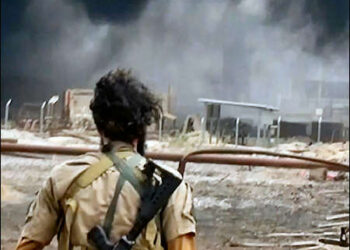
An AFP reporting team met Haftan and several fighters in a bunker carved into a snow covered mountainous area close to the Iranian frontier.
The region, part of Iraq’s autonomous Kurdistan region, has long served as a base for Kurdish Iranian armed factions. Those groups have repeatedly faced cross border strikes from Iran.
Tehran has designated PJAK as a “terrorist” organization. Iranian Kurdish groups, including PJAK, have in the past engaged in clashes with Iranian security forces in Kurdish majority areas along the border.
In recent years, however, many of these factions have largely reduced their armed activity. From exile in Iraqi Kurdistan, they continue political campaigning against Iran’s Islamic republic.
Haftan said his movement has recently increased lobbying efforts following mass anti government protests in Iran. The demonstrations were met with a deadly crackdown by Iranian authorities.
The renewed activism also comes as the United States has carried out a military build up in the region on a scale not seen in decades.
If open conflict erupts, Haftan said he expects Iran could strike Kurdish opposition positions in northern Iraq. He also said Iranian authorities have already reinforced security and military deployments in Rojhelat Kurdistan, the Kurdish majority areas of western Iran.
The outcome of any potential US strikes, he said, would depend on their scope. If such action were to lead to regime change, groups like PJAK would seek to establish what he described as a decentralized system.
He said Iran has already experienced both monarchy and rule under the Supreme Leader, and that a new political model would be needed.

Last week, PJAK and four other exiled Kurdish Iranian groups announced the formation of a political coalition. The coalition’s goal is to seek the overthrow of the Islamic republic and ultimately secure Kurdish self determination.
Kurdish opposition organizations have long expressed support for anti government protests in Iran. Last month, they called for a general strike in solidarity with demonstrators.
In 2022, Iran launched deadly military strikes against exiled Kurdish Iranian militants. Tehran accused them of stirring unrest linked to protests triggered by the death in custody of Jina Mahsa Amini, a Kurdish Iranian woman.
“In Iran, the Kurds have been at the forefront of the struggle for democracy and freedom,” Haftan told AFP. “When one leads people, one must pay a price. We have paid in blood.”
The Kurdish population stretches across areas of Turkish Kurdistan, Syrian Kurdistan, Iraqi Kurdistan and Iranian Kurdistan, also known as Greater Kurdistan. In Iran, Kurds form one of the largest non Persian ethnic minority groups.
The Democratic Party of Iranian Kurdistan, or PDKI, is among the oldest and largest Kurdish Iranian opposition movements. The group has lost fighters and senior commanders in Iranian attacks, including three of its chiefs.
Mohammed Nazif Kader, a PDKI commander, told AFP by phone that his organization does not back Israeli or American attacks on Iran. “Our coalition relies on the Iranian people, especially the Kurds,” he said.
He added that if war were to break out, it could create what he described as an opportunity for the Iranian opposition to return and seek to establish a democratic system.

“We are on full alert and fully prepared,” Kader said. “And for all forms of struggle.”
PJAK, Partiya Jiyana Azad a Kurdistane, took up arms in 2004. The group seeks to create semi autonomous Kurdish regional entities or Kurdish federal states within Iran.
The organization has more than 3,000 armed members, and about half of them are women. PJAK is considered one of the most active Kurdish groups in Iranian Kurdistan.
PJAK is also a member of the Kurdistan Democratic Confederation, known as KCK, an alliance of Kurdish groups and divisions led by an elected Executive Council.
Since coming to power in 1979, Iran’s Islamic regime has enforced rules and policies that Kurdish sources say discriminate against Kurds in Iranian Kurdistan across social, political and economic sectors.
Kurds in Iran face limits in exercising their religious, economic and cultural rights. Parents are not allowed to register certain Kurdish names for their newborn children, Kurdish activists say.
Religious minorities that are mainly or partly Kurdish have also been subjected to measures that, according to Kurdish groups, are aimed at isolating and stigmatizing them.
In addition, Kurds report unequal access to jobs, adequate housing and political participation. Rights groups say these restrictions have contributed to long standing poverty in Kurdish areas, further deepening marginalization.
More than 12 million Kurds are estimated to live in Iranian Kurdistan.
(With files from AFP | Agencies)
Copyright © 2026 iKurd.net. All rights reserved.
Related posts:
 Kurdish PJAK rebels say ready to resist Iran, await uprising in Rojhelat
 The Assassination of Abdurrahman Ghassemlou: No Friends but the Mullahs?
 The Resurrection (Ba’ath) Party – Before the Iran-Iraq War
 The Suffocation of Iraq Kurdistan
 The Mustashar and the Jash – A View from the Position of ‘Iraqi National Unity’ on the ‘Descendants of Treason’
 Iran arrests 11 Kurdish PJAK members over “sabotage”
 The Suffering of Halabja
 Iranian Kurdish parties unite to defy Islamic republic
 Israel backing Kurdish plans to seize Iran border areas: sources
 Kurdish armed groups cross into Iranian Kurdistan from Iraqi Kurdistan: MIT