

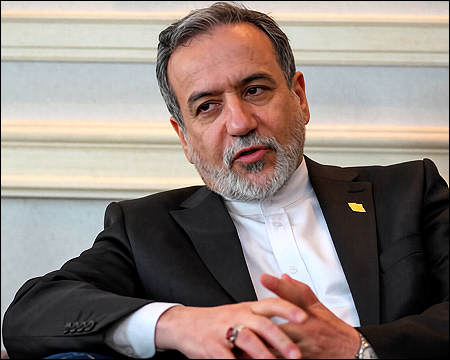
TEHRAN,— Iran says it is not currently enriching uranium at any of its nuclear sites, a move officials describe as a signal to the West that the country remains open to dialogue over its nuclear program.
Foreign Minister Abbas Araghchi made the announcement Sunday while speaking to an Associated Press journalist visiting Tehran.
His remarks come months after Israel and the United States conducted airstrikes on Iran’s enrichment facilities during a 12-day conflict in June.
“There is no undeclared nuclear enrichment in Iran. All of our facilities are under safeguards and monitoring by the International Atomic Energy Agency,” Araghchi said. “There is no enrichment at this moment because our enrichment sites have been attacked.”
Araghchi stressed Iran’s continued right to pursue nuclear technology for peaceful purposes. He said, “Iran’s right for enrichment, for peaceful use of nuclear technology, including enrichment, is undeniable.
We continue to exercise this right and expect the international community, including the United States, to acknowledge it. Iran will not give up its rights.”
The foreign minister’s comments were made during a summit in Tehran, where journalists were granted three-day visas to cover the event alongside media from the United Kingdom and elsewhere.
Mohammad Eslami, head of Iran’s Atomic Energy Organization, also spoke at the summit.
He said Tehran faces ongoing threats over potential work at the attacked sites. Satellite images indicate no major activity has taken place at Fordo, Isfahan, and Natanz since the strikes.
“Our security situation is still tense. Every day we face threats of attacks,” Eslami said. “We are warned that touching anything could trigger another assault.”
Iran previously enriched uranium to 60 percent purity, close to weapons-grade levels, after the U.S. exited the 2015 nuclear deal under President Donald Trump in 2018.
Tehran maintains its program is peaceful, though Western nations and the IAEA have stated Iran had a nuclear weapons program prior to 2003.
In September, European nations moved to reinstate United Nations sanctions on Iran in response to its nuclear activities. The IAEA’s Board of Governors is expected to meet this week to consider a resolution over Iran’s cooperation with the agency.
While Araghchi criticized U.S. demands as “maximalist and excessive,” he did not rule out future negotiations should Washington adjust its position.
“So far, the Americans have tried to impose their demands. We see no room for dialogue under these conditions,” he said.
The summit, organized by Iran’s Institute for Political and International Studies, focused on legal arguments regarding self-defense and aggression.
Entitled “International Law Under Assault: Aggression and Self-Defense,” it featured analyses from Iranian scholars defending the country’s response to the June conflict.
Mohammad Kazem Sajjadpour, a professor of international relations, described Iran’s defensive actions as “remarkable, inspiring, historic and above all, pure,” contrasting them with what he termed Israel’s “dirty deeds.”
The event was held in the Martyr General Qassem Soleimani Building, named for the late Revolutionary Guard commander killed by a U.S. drone in 2020. Outside the venue, photographs of children killed during the conflict were displayed.
Even as officials highlight their defensive posture, Iran faces ongoing vulnerabilities. Israel’s airstrikes destroyed much of the country’s air defense capabilities, leaving the door open for further attacks.
Economic difficulties and social issues also continue to pressure Iran’s government, including potential decisions over fuel subsidies and enforcement of mandatory hijab rules, which have previously sparked widespread protests.
(With files from AP)
Copyright © 2025 iKurd.net. All rights reserved.
Related posts:
 The Resurrection (Ba’ath) Party – Before the Iran-Iraq War
 If all emblems are correct? US & Iran tilting nuclear deal reach
 Iraq: Revenge and Corruption
 Saddam Hussein was a Friend to the West
 US and Israel launch wide ranging attack on Iran
 Iran – Toxic Theocracy – Part I
 The 12-Day War: A Tactical Failure, Yet a Strategic Win for Israel
 The Assassination of Abdurrahman Ghassemlou: No Friends but the Mullahs?
 What makes a good NATO ally? The Case of Turkey
 Israel hits Iran’s nuclear facilities as Tehran responds with drones