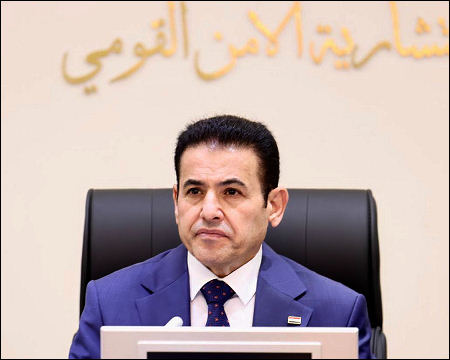
BAGHDAD,— Iraq’s national security adviser said Wednesday that Kurdish security Peshmarga forces have strengthened their presence along the border with Iran to prevent any armed groups from crossing into Iranian territory or launching attacks from Iraq.
Qassem al-Araji made the remarks during a phone call with Ali Bagheri, Deputy Secretary of the Supreme National Security Council of the Islamic Republic of Iran.
He said Iraq’s Prime Minister Mohammed Shia al-Sudani had issued clear orders that no organization would be allowed to “infiltrate into Iran and carry out terrorist acts from Iraqi territory.”
Araji stated that authorities in the Kurdistan region had deployed additional forces to the border area facing Iran from the direction of Erbil, the capital of Iraqi Kurdistan. He said the reinforcements were aimed at tightening full control over the border strip.
He also noted that Sudani had instructed officials to strictly implement a security agreement signed between Iraq and Iran in 2023.
The deal focuses on protecting their shared borders and addressing the presence of Iranian Kurdish opposition groups operating inside Iraqi Kurdistan.
Iraq and Iran had earlier agreed to disarm Kurdish-Iranian rebel groups and relocate them away from border areas. Tehran has long accused these groups of acting in the interests of Western or Israeli powers, an accusation the groups deny.
The developments come as Iraqi Kurdistan has been drawn into broader tensions across the Middle East. In recent months, drones have threatened U.S. bases in Iraq, and several attacks in the Kurdish region have been blamed on Iran. Tehran has said it is targeting Kurdish-Iranian armed factions it considers hostile.
Since Tuesday, two Iranian Kurdish groups have accused Iran of striking their positions inside Iraqi Kurdistan. On Wednesday, Iran’s Revolutionary Guards confirmed they had carried out missile strikes against what they described as armed opposition groups.
In a statement carried by Iranian media, the Guards said that “bases and headquarters of Komala and anti-revolutionary groups were hit with success by three missiles” launched at 11:00 a.m. local time, or 0730 GMT.
The statement said the targets were located in the autonomous Kurdish region of neighboring Iraq. Last month, five Iranian Kurdish opposition groups based in exile announced the formation of a political coalition.
They said their main goal is “the struggle to overthrow the Islamic republic of Iran, and to achieve self-determination for the Kurds.”
Among the groups involved are the Democratic Party of Iranian Kurdistan and the Kurdistan Freedom Party.
On Wednesday, Mustafa Hijri, secretary general of the Democratic Party of Iranian Kurdistan PDKI, called on Iranian soldiers and security personnel, especially those stationed in Kurdistan, to leave their posts and desert the Iranian forces.
Separately, an exiled Iranian Kurdish group reported casualties from what it described as an Iranian rocket strike.
In Erbil, a spokesman for the Kurdistan Freedom Party said the attack targeted one of the group’s camps near the city. Khalil Sanani told AFP that three rockets were fired at 11:22 a.m. local time, or 0822 GMT, at a camp housing fighters and their families.
“One guard was killed and another three wounded,” Sanani said.
The camp belongs to the Kurdistan Freedom Party, also known as PAK, which operates from Iraqi Kurdistan.
The region hosts camps and rear bases used by several Iranian Kurdish groups. These groups have repeatedly faced cross-border strikes from Iran over the years.
On Tuesday, drone strikes blamed on Iran also hit a camp belonging to the PDKI. The group said its facilities were targeted, though details of casualties were not immediately clear.
Iran has designated several Kurdish opposition movements as “terrorist” organizations. In the past, some of these groups fought Iranian security forces in Kurdish areas along the border, including in Iranian Kurdistan. In recent years, however, they have largely avoided armed activity and have focused on political work from exile.
Despite that, tensions have continued. Tehran maintains that it will not tolerate armed opposition groups near its borders.
Iraqi officials have repeatedly said they do not want Iraqi territory to be used as a launchpad for attacks against neighboring countries.
The situation highlights the fragile balance in Iraqi Kurdistan, which lies close to both Iranian Kurdistan and Turkish Kurdistan and has often been affected by regional rivalries.
Iraqi authorities say they are committed to preventing further escalation and to enforcing agreements reached with Tehran.
The renewed strikes and political moves by exiled Kurdish groups have added to pressure on Baghdad and the Kurdistan regional government as they seek to manage relations with Iran while maintaining internal security.
(With files from AFP)
Copyright © 2026 iKurd.net. All rights reserved.
Related posts:
 The Resurrection (Ba’ath) Party – Before the Iran-Iraq War
 The Suffocation of Iraq Kurdistan
 The Assassination of Abdurrahman Ghassemlou: No Friends but the Mullahs?
 The Mustashar and the Jash – A View from the Position of ‘Iraqi National Unity’ on the ‘Descendants of Treason’
 Business with ISIS – Updated
 Saddam Hussein was a Friend to the West
 Iraq: A State of Surveillance – Databases, Tracking And Corruption
 Iraq: Revenge and Corruption
 Saddam Hussein’s Enemies: Paving the Road to the Invasion of Iraq
 Iraq in the Shadow of Khomeinism – Part I: Baghdad And Erbil Under Threat