

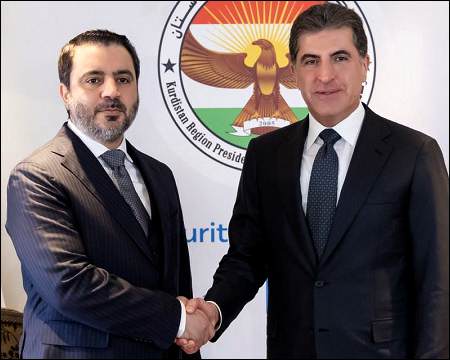
MUNICH,— Iraqi Kurdistan Region President Nechirvan Barzani met with Syria’s interim foreign minister, Asaad al-Shaibani, on Saturday during the Munich Security Conference, as Kurdish leaders voice concerns about their exclusion from ongoing discussions regarding Syria’s political future.
Shaibani represents the interim Islamist administration in Damascus, which emerged after Hayat Tahrir al-Sham (HTS), a militant group formerly affiliated with al-Qaeda, led an offensive in December 2024 that resulted in the removal of President Bashar al-Assad.
HTS, previously known as the Nusra Front, is designated as a terrorist organization by the United States, the United Nations, and other international bodies.
During their meeting, Barzani and Shaibani discussed political and security developments in Iraq and Syria, as well as efforts to promote regional stability, according to a statement from the Kurdistan Region Presidency.
Barzani stressed the need for dialogue and cooperation among all Syrian factions to ensure a “stable future for all.” The discussion comes as Syria’s interim administration plans to hold a National Dialogue Conference aimed at paving the way for new elections.
On Wednesday, Transitional President Ahmed al-Sharaa announced the formation of a preparatory committee to organize the conference. However, Kurdish political parties in Syrian Kurdistan (Rojava) have criticized the committee for failing to include Kurdish representatives.
According to the Kurdistan Region’s statement, Barzani raised concerns over the rights of Syria’s ethnic and religious minorities, including Kurds, and emphasized the importance of their participation in shaping the country’s future.
However, the statement did not clarify whether Barzani was advocating for the US-backed Kurdish-led Syrian Democratic Forces (SDF), which control about 25% of Syria, or for the Kurdish National Council (ENKS), a smaller faction supported by Turkey and the Kurdistan Democratic Party (KDP), led by the Barzani family.
Analysts note that the Barzani-led Kurdistan Regional Government (KRG) has maintained an economic blockade on Syrian Kurdistan for over a decade by keeping the border crossing between the Kurdistan Region of Iraq and Syrian Kurdistan closed, reportedly due to political considerations and to please Turkey.
According to analysts the ENKS and the pro-Turkey Syrian Peshmerga (Roj) forces operate from the Kurdistan Region of Iraq, with no established foothold in Syrian Kurdistan (Rojava). Formed with backing from Turkey and the Barzani’s KDP, these groups are seen as external actors attempting to gain influence in northeastern Syria. Both Ankara and the Barzanis have pushed for their integration into the region, aiming to challenge the authority of the Kurdish-led administration and its military forces.
Shaibani said Syria remains committed to stability and creating the right conditions for national talks, according to the statement. He also emphasized Syria’s interest in strengthening ties with Iraq and the Kurdistan Region to enhance cooperation on regional security and other challenges.
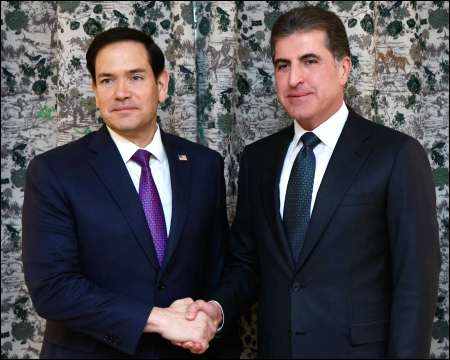
In a separate meeting on Saturday, Nechirvan Barzani held talks with U.S. Secretary of State Marco Rubio on Saturday on the sidelines of the Munich Security Conference, where they reaffirmed the longstanding partnership between the United States, Iraq, and the Kurdistan Region.
Their discussions focused on regional security, counterterrorism efforts, and the future of U.S.-Kurdistan relations under the new U.S. administration.
Barzani acknowledged Washington’s continued support in the fight against terrorism, particularly efforts to combat ISIS in Iraq and Syria. He emphasized the need for ongoing cooperation to ensure stability in the region.
As part of their discussions, Barzani invited Rubio to attend the upcoming inauguration of the new U.S. Consulate General in Erbil, an invitation that the Secretary of State reportedly welcomed.
Rubio reaffirmed the United States’ commitment to its allies in Iraq and the Kurdistan Region, stressing the importance of continued military and security collaboration. He also highlighted economic development as a key factor in maintaining long-term regional stability.
Copyright © 2025 iKurd.net. All rights reserved
Related posts:
 The Resurrection (Ba’ath) Party – Before the Iran-Iraq War
 Business with ISIS – Updated
 Iraqi Kurdistan: The Emperors’ New Clothes
 Syrian Kurdish delegation meets U.S. Secretary of State Marco Rubio
 Iraqi Kurdistan – “Sold Out!” – Part II
 Iraq – The Cynical Swindle
 Martyrs for Millionaires: The Black-Market Politics behind the Theft of Syria’s Oil
 Stealing Syria
 The Mustashar and the Jash – A View from the Position of ‘Iraqi National Unity’ on the ‘Descendants of Treason’
 Saddam Hussein’s Enemies: Paving the Road to the Invasion of Iraq