


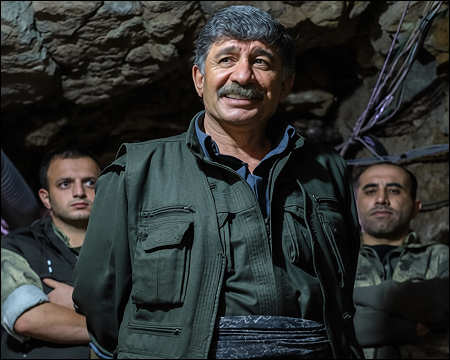
QANDIL MOUNTAINTS,— A senior commander of the Kurdistan Workers Party told AFP that the organization will halt further moves in its peace initiative with Turkey until Ankara advances talks by releasing Abdullah Ocalan, the Kurdish leader and founder of the PKK.
The commander, Amed Malazgirt, made the remarks in an interview conducted Saturday inside a bunker located in the Qandil mountains of Iraqi Kurdistan.
Malazgirt said the group had already fulfilled all steps initiated under Ocalan’s guidance and that it was now the responsibility of Turkey to move the process forward.
He stated that no additional action would be taken by the PKK unless Ankara responded with concrete measures.
According to Malazgirt, the group is focused on two key demands. He said the first is the release of Ocalan, who is often referred to by supporters as leader Apo.
He added that a successful peace process cannot be achieved without Ocalan’s freedom. The second demand is the constitutional and official recognition of the Kurdish people in Turkey.
Inside the bunker, PKK commanders and fighters sat in a warmed room decorated with portraits of Ocalan and fallen members of the group.
The bunker was ventilated and connected to other chambers by tunnels, including quarters specifically prepared for women fighters. AFP said its interviews were conducted using recording equipment supplied by the PKK, as the group does not allow outside devices for security purposes.
Female senior commander Serda Mazlum Gabar said the Kurdish people and PKK guerrillas cannot feel free as long as Ocalan remains in prison.
She emphasized that the group’s path toward freedom is tied to the liberation of its leadership. She added that they want Ocalan to be able to meet with the people.
Ocalan, 76, has played a leading role in the peace process from his cell on Imrali island. He has been held there since 1999, serving a life sentence. Turkish lawmakers from a special committee created to advance negotiations with the Kurds visited Ocalan earlier this week.
In recent months, the PKK, which has maintained a base in Iraqi Kurdistan mountains for decades, has taken several steps described as historic by the group.
These actions were meant to signal a shift away from its long armed confrontation with Turkey. The conflict has lasted for decades and has claimed tens of thousands of lives.
In May, the PKK formally stated that it was giving up its armed struggle. The group held a ceremony in Iraqi Kurdistan where 30 fighters symbolically burned their weapons to show commitment to the peace initiative.
Last month, the PKK announced it had begun withdrawing all its fighters from Turkish Kurdistan territory into Iraqi Kurdistan. Earlier this month, the group said it had left a key border zone in the same region.
Malazgirt said the PKK has honored its pledge not to use weapons against Turkey. Ankara began indirect talks with the organization late last year, and in February Ocalan called on the PKK to abandon armed tactics and adopt democratic avenues to advance Kurdish demands.
Turkey has created a cross-party parliamentary committee to prepare the political and legal groundwork for integrating PKK members into public political life. Malazgirt called the committee’s creation a positive step, though he said it is not sufficient by itself. He added that the PKK is observing the committee’s work closely.
PKK leaders say the group seeks to continue a democratic struggle to defend Kurdish rights. Serda Mazlum Gabar said they would prefer to carry out that struggle inside Turkey if conditions were open for democratic politics.
She said the PKK is prepared for such a shift but added that the guerrilla movement also represents what she described as a model of free life. According to her, the organization must reorganize itself, undergo restoration and apply new approaches. She added that the guerrilla movement may continue in different forms and will not fully disappear.
The PKK took up arms in 1984 in what it described as a push for greater autonomy for Kurds in areas often referred to as Turkish Kurdistan (Bashur Kurdistan).
The conflict has caused large numbers of casualties among Turkish soldiers and Kurdish guerrillas. Many Kurds in Turkey and abroad continue to view Ocalan as a central figure in their struggle for cultural rights and democratic freedoms. Observers often describe him as a symbol of Kurdish aspirations.
(With files from AFP | Agencies)
Copyright © 2025 iKurd.net. All rights reserved.
Related posts:
 Turkey: The Psychological War Against the Kurds Through the PKK – Part I
 Business with ISIS – Updated
 The PKK’s Personality Cult: Changing Influences – Part II
 Debunked PKK Leader Ocalan Will Never Be Set Free
 What makes a good NATO ally? The Case of Turkey
 Distorting the Kurdish Question in Turkey
 Turkey’s Parliamentary Approval to Dissolve the PKK
 Turkey: Nato’s Islamic State Member
 Can Apo Save The Kurds?
 There is no hope in Ocalan’s unilateral peace initiative