

Dr. Amir Sharifi | Exclusive to iKurd.net
The Islamic Republic of Iran has embarked on an intense repression, in particular after it faced an intensive resistance following jina/Mahasa Amini’s brutal murder by the morality police on Sept 16, 2022.
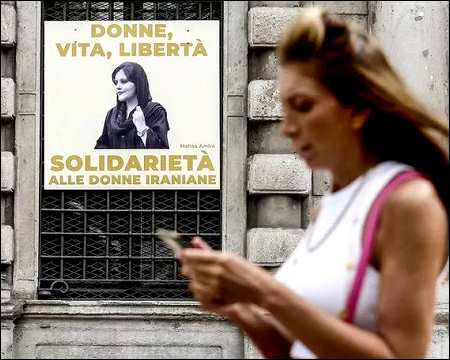
The feminist uprising began in Kurdish areas and spread like wildfire initially locally and then globally through social media with the Kurdish slogan of “jin, jiyan, Azadi” Woman, Life, and Freedom, calling for an end to the Shi’ite clerical rule and its patriarchal system throughout Iran.
It was the greatest feminist uprising ever seen in depth and breadth. Ensuing reports publicized the tragedy of the 22-year-old Jina Amini-Niloufar Hamedi and Elahe Mohammadi, two journalists who were imprisoned for their hospital report and jina’s funeral respectively.
In the course of eight months, more than 700 people were killed, 71 of them children; over 30, 000 people were arrested, many executed. Even a 9-year-old boy was shot dead by the security forces; many young girls and boys were raped as a parcel of draconian repression.
With commemoration of Jina / Mahsa Amini’s tragic death, a new spate of terror and repression began. The security forces threatened the family of Amini against marking Jina’s anniversary. Kurdish Human Rights Organization, Hengaw reported the parents would hold a commemorative event at Jina Amini’s gravesite in her hometown of Saghez. The latest reports indicate all access roads were blocked by the security forces and their tanks and heavy artillery.
Hengaw Human Rights Association reports that the Islamic Republic has doubled down on draconian measures against anyone suspected of political and human rights activism and that there was an increase in arbitrary arrests and abductions a “17% [increase] compared to July of last year… women (36), children (11), Gilakis (22), Balochis (14), Azeri Turks (14), Bahais (17), Kurds (116). The report indicates that “44% were Kurdish citizens.” This trend and litany of violating the personal and international law against ethnic and religious minorities has increased.

The military dictatorship of theocracy upheld by the Supreme leader and the IRGC (Sepeh-e Pasdaran-e-Engelab-e-Eslami) saw the hope and optimism of many and feared its own fall. Consequently, it used brute force to sustain a regime that had lost all its legitimacy even among its adherents.
Yet the universal slogan “Woman, Life, Freedom” has continued to withstand the savage onslaught of the regime, bent on not allowing the uprising to deepen into a revolution organized by civic and progressive organizations throughout Iran.
That is why family members and even lawyers of families who have lost their daughters and sons had been summoned and arrested, those provisionally freed have been threatened not to engage in any commemorative events and activities on the anniversary of Jina Amini’s death. The increase in arbitrary arrests and harassment of girls and young women as reported by the UN investigation, unveils the schizophrenia of the Islamic Regime.
The new feminist uprising that rocked the Shi’ite clerical rule and its system of gender apartheid is bound to continue till the collapse of theocracy. Widespread strikes have been reported in the highly militarized Kurdish towns and major city centers contrary to the regime’s, IRNA in its Goebel like propaganda announced Amini’s hometown was “completely quiet” due to “the vigilance and the presence of security and military forces”.
On the eve of Jina /Mahsa’s death, the regime in Iran had put Amjad Amini, the father of Jina/Mahsa Amini, under house arrest and militarily blocked and flooded access to the cemetery where Jina is buried. Kurds at home or in exile marked the anniversary as the rising repression threatens them as the harbingers of the new feminist uprising.
Protests will not settle down. Women continued to tear off their scarves despite harsher rules and decrees; Kurds and other ethnic groups such as Baluchis will continue to fight for their basic rights such as the right to education in their mother tongue and socio-cultural and linguistic self-determination despite theocratic and nationalist oppositions.
Resistance in the Kurdish city of Sne manifested itself by once again barricading the streets. Most stores and shops in at least 18 Kurdish cities had closed down in a general strike. Once again, the Kurdish population, women, girls, men and boys will pour into the streets in hundreds of thousands; they will create more barricades to bring down the regime.
Women will seek gender equity; they will dance and chant revolutionary and secular songs; Universities and high schools will continue to be citadels of resistance; more professors will rise in solidarity with their students and in defence of academic freedom.
The Kurdish participation in Jina Amini’s uprising was fostered by civic and human rights associations and sustained by the tradition of collective will in defense of freedom and socio-economic rights.
However, the rest of Iran did not rise to support the Kurdish revolutionary movement as the national hierarchy and cries of “independence” from the regime motivated royalists and Iranian nationalism to adopt their own defeating slogans of “territorial integrity “against “separatists” as the Islamic Republic succeeded to “divide and conquer.
The increased repression in “Kurdistan” enhances the political importance of the Kurdish resistance that continues to pose an existential threat to the entirety of the regime in Iran.
As we reflect on the slogan of “woman, life, freedom” and its symbolic significance one year after, we will continue to align ourselves with the true advocates of democracy in 2022; women have played a long and extensive role in the revolutionary uprising against the patriarchal culture in civil and political walks of life and resistance to oppression in their quest for equity and an inclusive democracy in which the youth men and women, workers, ethnic and religious minorities participate.
That is why the Islamic Republic is determined to annihilate their struggle against Hejab and other patriarchal structures of discrimination and violence as arrests and harassment against women and girls are on the rise, according to Amnesty International and UN investigations.
The violence unleashed against women and Kurds bespeaks of both patriarchy and politics of exclusion and erasure; yet feminist uprising is ultimately emancipatory as it is inclusive of diversity, the very basis on which a genuine democracy rests.
Dr Amir Sharifi, a lecturer at California State University, Department of Linguistics, Long Beach.
The opinions are those of the writer and do not necessarily represent the views of iKurd.net or its editors.
Copyright © 2023 iKurd.net. All rights reserved
Related posts:
 The Sun Also Rises in Western Iran
 Iran Regime Change Vs. Map Change
 Jina Renaissance in 1001 words
 The Resurrection (Ba’ath) Party – Before the Iran-Iraq War
 Farewell to Iran, Peace from Rojhelat Kurdistan, Land of the Rising Sun
 The Rojava Revolution Has Lessons for Western Feminism
 The Mustashar and the Jash – A View from the Position of ‘Iraqi National Unity’ on the ‘Descendants of Treason’
 Iran did not allow Mahsa Amini to use her Kurdish first name ‘Jina’: document
 Who Are the Persians, Part V
 Unpopular Mojahedin-e-Khalq leader urges Iranians to topple Khamenei