

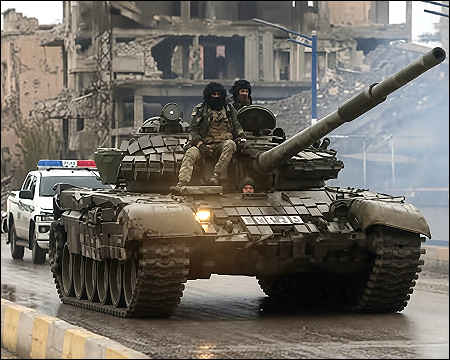
DEIR EZZOR,— Islamist militias operating under Syria’s interim government moved on Monday into areas of eastern and northern Syria that had been administered by Kurdish authorities for years, a day after a ceasefire was announced between Damascus and the Kurdish leadership.
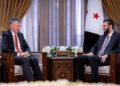
The deployment followed an agreement reached between interim president Ahmed al-Sharaa and Syrian Democratic Forces commander, General Mazloum Abdi, with both sides preparing for direct talks aimed at reshaping control over large parts of the country’s northeast.
Despite public statements describing the accord as a step toward stability, violence continued on the ground.
The government Islamist militias accused Kurdish forces of attacking its positions, while the US-backed SDF said Sharaa militias initiated clashes near sensitive security sites.
The militias, often referred to by Damascus as the Syrian army, claimed three of their members were killed in incidents they blamed on what they called terrorist groups attempting to undermine the agreement.
They did not disclose precise locations or provide independent verification.
The SDF rejected that account, saying Islamist factions loyal to al-Sharaa launched assaults near a prison complex in Raqa that holds Islamic State detainees.
The Kurdish force described the confrontations as violent and warned of risks to detention facilities that house thousands of Islamic State ISIS militants and their families.
The ceasefire came after weeks of pressure on Kurdish-held areas and days after government militias advanced into neighborhoods of Aleppo previously controlled by Kurdish units.
Kurdish forces withdrew rather than fight, relocating toward Syrian Kurdistan and avoiding urban warfare.
Analysts said the deal effectively dismantles the self-rule system Kurds established across much of north and northeast Syria during more than a decade of conflict.
In Deir Ezzor province, witnesses reported long convoys of military vehicles moving toward the east bank of the Euphrates River. Trucks, private cars, and pedestrians crowded a narrow bridge as people attempted to cross ahead of further deployments.
A statement from the so-called Syrian army said its forces had begun securing the north and east under the terms of the agreement and had reached areas near Hasaka city, the administrative center of Kurdish authority in the region.
The agreement calls for the Kurdish administration’s immediate handover of the Arab-majority provinces of Deir Ezzor and Raqa to Damascus.
Under the terms of the deal, the government is to assume responsibility for prisons and camps holding Islamic State detainees and their families that are currently run by Kurdish authorities, a shift that would end years of Kurdish management of the facilities.
So far, Syrian Kurdish forces have not handed over any prisons holding ISIS detainees to Syrian government militias.
Ahmed al-Sharaa, also known as Abu Mohammed al-Golani, assumed the role of interim president following the collapse of Syria’s former government. His background includes previous leadership roles within ISIS, al-Qaeda, and later the al-Nusra Front, which was rebranded as Hayat Tahrir al-Sham.
The SDF captured large areas of Deir Ezzor and Raqa during the campaign against ISIS, fighting alongside an international coalition led by the United States. Kurdish-led fighters jointly expelled ISIS jihadist group, establishing control over oil fields, cities, and detention sites.
On Sunday, the SDF withdrew from several locations in eastern Deir Ezzor, including the Al-Omar oil field, Syria’s largest, and the nearby Tanak field.
Local Arab tribal fighters aligned with Damascus moved in before government militias formally arrived.
Some of those Arab tribes had previously worked with the SDF, which includes Arab units alongside Kurdish forces. Shifting alliances in the province have long reflected local grievances and competition over resources.
A senior official at Syria’s energy ministry said technical teams were dispatched to assess oil facilities taken over in recent days, speaking on state television.
Mazloum Abdi said he accepted the agreement to prevent a wider civil conflict and to end what he described as a confrontation imposed on Kurdish communities after months of deadlocked talks.
All the territories from which Kurdish forces withdrew were majority Arab areas, previously administered by the Kurds under an agreement with the US-led international coalition.
Political analyst Henase Karim told iKurd News that the Kurds lacked sufficient troops to defend all of their territory, which is why they withdrew. Karim added that the Kurdish forces also do not have the support of local populations, which are predominantly Arab.
She said the real conflict will occur if Syrian government militias launch attacks on Kurdish areas in Syrian Kurdistan, particularly in Hasaka and al-Jazeera.
Karim said such a move would come at an extremely high cost for the government militias, adding that they would not be able to seize any Kurdish land.
She said the areas are Kurdish territory and that Kurdish forces and residents would defend them at all costs. However, Karim said she does not believe Sharaa’s militias will attempt a direct assault on the Kurdish region.
Mutlu Civiroglu, a Washington-based Kurdish affairs analyst, said the Islamist advance casts doubt on the durability of the ceasefire and earlier understandings reached in March.
He said pressure on Kurdish areas, following earlier confrontations with Alawite communities on the coast and Druze regions in Sweida, undermines claims that the interim government represents Syria’s diverse population.
Syria has a population of approximately 20 million, including roughly two million Kurds, with about 1.2 million residing in Syrian Kurdistan.
(With files from AFP | Agencies)
Copyright © 2026 iKurd.net. All rights reserved.
Related posts:
 Business with ISIS – Updated
 The Resurrection (Ba’ath) Party – Before the Iran-Iraq War
 Stealing Syria
 Turkey: Nato’s Islamic State Member
 Syria: A ‘Caliphate’ by Any Other Name — Would Smell the Same
 Syrian Kurdish forces enter Deir Ezzor as Assad forces pull back
 Sabotaging Syria
 Syria: Revisiting The Caesar Torture Victim Photographs
 Syrian gov’t Islamist militants massacre a Kurdish family: video
 Interview with Kurdish hostage, Huseyin Baybasin