


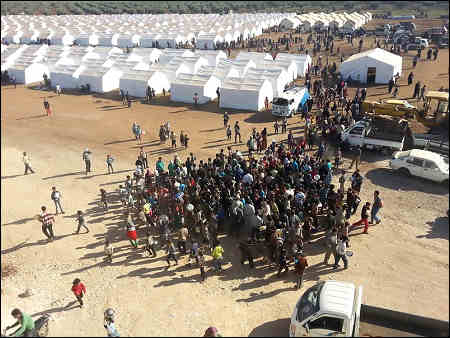
DAMASCUS,— Syria has started evacuating the remaining residents of Al-Hol camp, which long housed relatives of Islamic State IS/ISIS group fighters, two officials told AFP.
The operation comes as the government takes full control of the facility, formerly managed by Kurdish authorities.
Al-Hol, situated in the desert area of Hasaka province, has been Syria’s largest camp for families of suspected IS fighters.
Last month, Syrian authorities assumed control after Kurdish forces withdrew from parts of northeastern Syria, handing over territory to Damascus.
Since the takeover, thousands of families of foreign fighters have left the camp, heading to destinations that have not been disclosed.
The facility had held roughly 24,000 people, mostly Syrians, along with Iraqis and over 6,000 individuals from about 40 other countries.
Fadi al-Qassem, the official appointed by the government to oversee Al-Hol, told AFP that the camp “lacks the basic conditions for habitation,” and that authorities decided to relocate residents to camps in Aleppo province.
He added, “The evacuation started today and will be completed within a week. Nobody will remain.”
Political analyst Henase Karim told iKurd News that the move was expected and that authorities are not formally evacuating residents but simply opening the camp’s gates and freeing everyone. She added that the camp is now almost empty.
She said the Syrian government and its armed forces are largely composed of former Islamic State fighters and members.
Karim added that authorities are actively working to free relatives of IS fighters and are likely to integrate the adults into government forces.
She noted that if the United States had not relocated thousands of IS detainees from Syria to Iraq, and if the Syrian authorities had taken full control of the prisons, they would have released the majority of prisoners and absorbed them into their ranks.
A government source, speaking on condition of anonymity, said the ministry of emergencies and disaster management is coordinating the relocation. Vehicles carrying residents have already left for Akhtarin, a camp in northern Aleppo province.
Humanitarian groups reported last week that the camp’s population has sharply declined since Kurdish forces left. Many foreign families departed and smuggled, while local Syrians and Iraqis remain in smaller numbers.
The Kurdish Syrian Democratic Forces announced on January 20 that they had to withdraw from Al-Hol. Syrian army officials entered the camp the following day.
The camp’s high-security section had housed the most radical foreign Muslim women and children, including those from Russia, the Caucasus, and Central Asia. This section was separated from Syrian and Iraqi residents.
Celine Schmitt, a spokesperson for the United Nations refugee agency UNHCR in Syria, told AFP that “UNHCR has observed a significant decrease in the number of residents in Al-Hol camp in recent weeks.”
She added that the government plans to relocate the remaining residents to Akhtarin camp and requested UN assistance for the process.
Schmitt said the authorities need to identify foreign nationals who have left the camp to allow proper repatriation procedures.
Kurdish forces continue to control the Roj camp in Syrian Kurdistan (Rojava), which holds about 2,200 people from roughly 50 nationalities, including relatives of foreign jihadists.
On Monday, Kurdish authorities released 34 Australians from Roj, but they were returned due to coordination issues with Damascus, according to Kurdish officials. Australia reportedly declined to assist.
The US military recently transferred thousands of IS suspects, including Syrians and Western nationals, from Kurdish-run prisons in northeast Syria to Iraq.
Human Rights Watch warned that the roughly 5,700 detainees transferred may face enforced disappearance, unfair trials, torture, or other violations.
Kurdish authorities have repeatedly urged countries to repatriate their citizens, but most nations have only returned a small number of people.
(With files from AFP)
Copyright © 2026 iKurd.net. All rights reserved.
Related posts:
 Business with ISIS – Updated
 Syria’s Massacres of Christians, Alawites, Druze, and Shi’as…
 The Resurrection (Ba’ath) Party – Before the Iran-Iraq War
 Sabotaging Syria
 Most foreign IS families depart Syria’s Al-Hol camp: Humanitarian sources
 Syria shuts Islamic State-linked al Hol camp after emptying it
 Syria: Revisiting The Caesar Torture Victim Photographs
 Syria: A ‘Caliphate’ by Any Other Name — Would Smell the Same
 Turkey: Nato’s Islamic State Member
 Syria confirms mass escape of Islamic State relatives from al-Hol camp