


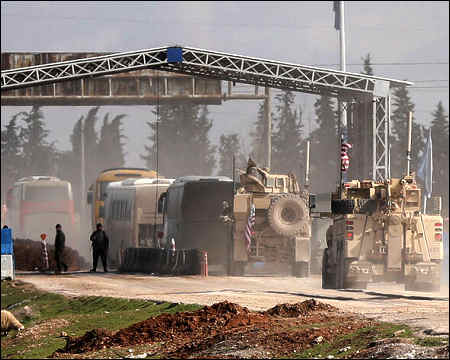
BAGHDAD,—The United States Central Command said Friday that it has completed moving thousands of Islamic State IS/ISIS fighters from Syria to Iraq, ending a 23 day operation that involved flights and ground coordination between both countries.
In a statement, CENTCOM said the transfer followed a nighttime flight from northeastern Syria to Iraq on Feb 12.
The move was carried out to make sure that Islamic State detainees remain secure in prison facilities. The command said the mission began on Jan 21 and resulted in U.S. forces transporting more than 5,700 adult male ISIS fighters from detention sites in Syrian Kurdistan to Iraqi custody.
The United States had earlier announced plans to transfer about 7,000 detainees.
For years, the suspects were held in prisons run by Kurdish led forces in Syrian Kurdistan. The situation changed after Syrian government Islamist troops pushed Kurdish forces out of large parts of northern Syria.
As Damascus regained control over surrounding areas, Washington decided to intervene over concerns about the safety of the detainees.
Islamic State swept across Syria and Iraq in 2014. The group carried out mass killings and forced Kurdish women and girls into sexual slavery.
Iraq declared victory over the group in 2017 with support from a U.S. led coalition. In Syria, the Kurdish led Syrian Democratic Forces SDF defeated the group two years later.
More than 21,000 Kurdish male and female SDF/YPG fighters were killed in fight against Islamic State and pro-Turkey Syrian Islamist mercenary groups.
After that, the SDF detained thousands of suspected jihadi fighters and held tens of thousands of their relatives in camps across northeastern Syria.
Security concerns grew last month when Syrian interim government Islamist forces advanced into areas previously controlled by Kurdish forces.
Questions arose over what would happen to the Islamic State prisoners. The United States said the transfer was meant to prevent a possible breakout that could threaten the region.
Admiral Brad Cooper, head of CENTCOM, thanked Iraq for its cooperation. “We appreciate Iraq’s leadership and recognition that transferring the detainees is essential to regional security,” he said in the statement.
He also praised the Joint Force team that carried out the operation, calling it a challenging mission completed with focus and professionalism in coordination with regional partners.
A senior Iraqi security source told AFP earlier this week that most of the detainees are Syrian nationals.
However, there are also hundreds of foreign nationals among them, including individuals from Arab countries as well as Europe, Asia and Australia.
The detainees from Syria were taken to Baghdad’s al Karkh prison. The facility was once known as Camp Cropper, where former Iraqi ruler Saddam Hussein was held before his execution.
To prepare for the arrivals, Iraqi authorities moved thousands of existing inmates from al Karkh prison to other facilities. A lawyer and an inmate confirmed the transfers to AFP on condition of anonymity.
Iraq’s judiciary said earlier this month that it had started investigations into the detainees who were transferred from Syria. Under Iraqi law, people convicted of terrorism or murder can face the death penalty. Any execution order must be signed by the president.
Over the years, Iraqi courts have issued hundreds of death sentences and life imprisonment terms against people convicted of terrorism offenses, including foreign fighters linked to the Islamic State group.
Iraq has repeatedly urged other countries to repatriate their citizens who are among the Islamic State detainees. So far, those calls have seen little response.
Kurdish forces in Syria also called for foreign governments to take back their nationals. Repatriation efforts were limited and focused mainly on women and children held in detention camps.
Humanitarian sources told AFP on Thursday that most Islamic State foreign families have now left the Al Hol camp in northeastern Syria.
Many foreign residents of al-Hol camp were smuggled to Idlib, says a humanitarian source.
The camp held relatives of Islamic State fighters and was previously guarded by Kurdish forces. Last month, the Syrian government assumed control of the camp after Kurdish forces withdrew as Damascus expanded its authority across large areas of northeastern Syria.
(With files from AFP)
Copyright © 2026 iKurd.net. All rights reserved.
Related posts:
 Business with ISIS – Updated
 The Resurrection (Ba’ath) Party – Before the Iran-Iraq War
 Syria: Revisiting The Caesar Torture Victim Photographs
 Syria: The Triumph of Terrorism
 Saddam Hussein’s Enemies: Paving the Road to the Invasion of Iraq
 Iraq: Revenge and Corruption
 Turkey: Nato’s Islamic State Member
 Iraqi Kurdistan – “Sold Out!” – Part II
 Saddam Hussein was a Friend to the West
 Sabotaging Syria