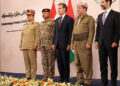



RIYADH,— Syria’s transitional Islamist president, Ahmed al-Sharaa, met with Saudi Crown Prince Mohammed bin Salman in Riyadh on Sunday, marking his first official foreign visit since taking office.
The meeting signals a major realignment in regional politics following the ousting of longtime leader Bashar al-Assad.
Sharaa, who assumed power last week after leading a rebel offensive that removed Assad, discussed economic and humanitarian cooperation with the Saudi leader. In a written statement, Sharaa said the talks covered “extensive future plans” in energy, technology, education, and healthcare.
Saudi Arabia’s state news agency confirmed the meeting, stating that discussions focused on strengthening bilateral ties and regional developments.
Sharaa, also known as Abu Mohammad al-Golani, is the leader of the Islamist group Hayat Tahrir al-Sham (HTS), formerly the al-Nusra Front, which was once affiliated with al-Qaeda. Before founding al-Nusra, he was a leading member of the Islamic State (IS/ISIS) group. His rise to power marks a dramatic shift in Syria’s leadership after more than a decade of civil war.
Born in Saudi Arabia, Sharaa spent part of his childhood in the kingdom. He was expected to remain in the country on Monday for a visit to the Muslim holy city of Mecca.
Since Assad’s removal, Syria’s new leadership has sought to rebuild relationships with both Arab and Western nations. Saudi Arabia has been at the forefront of these efforts, hosting Syria’s new foreign and defense ministers in early January, followed by a high-level meeting of Syrian, Arab, and Western officials later that month.
Qatar’s Emir, Sheikh Tamim bin Hamad Al-Thani, was the first head of state to visit Damascus after Assad’s ouster in December, signaling a shift in diplomatic engagement with Syria’s new government.
The improved relations stand in stark contrast to Syria’s status under Assad. His brutal crackdown on protests in 2011 led to Syria’s suspension from the Arab League for over a decade.
In 2023, Saudi Arabia spearheaded efforts to reintegrate Assad into the regional fold, hoping to address security concerns, including the production and trafficking of captagon, an amphetamine-like drug popular in the Gulf.
Regional security sources identified Syria as the leading producer of the drug in the region. While Assad’s government denied involvement, little progress was made to curb its production and trade.
Syria’s new Islamist leadership has pledged to take a tougher stance on drug trafficking, according to officials.
(With files from Reuters)
Copyright © 2025 iKurd.net. All rights reserved
Related posts:
 The Resurrection (Ba’ath) Party – Before the Iran-Iraq War
 Stealing Syria
 Business with ISIS – Updated
 Turkey: The Psychological War Against the Kurds Through the PKK – Part I
 Syria: A ‘Caliphate’ by Any Other Name — Would Smell the Same
 Trump meets Sharra, vows to lift sanctions on Syria
 The Islamic State of Syria? (Al Dawla al-Islamiya fi al-Sham)
 Hostages to Jihad – Austin Tice, The Long Missing American in Syria – Part One
 Saddam Hussein was a Friend to the West
 Syria: The Hijacking of the Arab Spring: From ISIS to Hayat Tahrir al-Sham