


Trump’s Threats to Iran Are Real. But Will His Scale of Action Match His Words?
Syafruddin Arsyad | Exclusive to iKurd.net
As the United States’ warships gather near Iran, and Washington simultaneously signals openness to dialogue, it appears that the U.S. is intending to use military force to earn diplomatic leverage without a clearly defined political endgame. This dual-track approach intends to pressure Tehran into concessions. However, for protesters inside Iran, and for the U.S. allies watching closely, the stakes extend far beyond diplomatic signalling.
Military Posturing and Diplomatic Signals
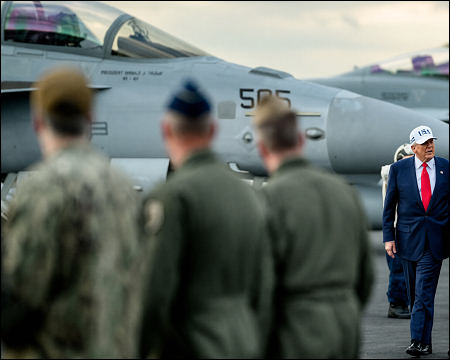
The U.S. is signalling that military action against Iran is looming, as it has deployed an “armada”—an aircraft carrier accompanied by warships, fighter jets and thousands of troops— to the Gulf region. Simultaneously, the U.S. officials, in contrast to this bold military posturing, sound a little soft when they speak about the possibility of dialogue with their Iranian counterparts.
The U.S.’s deployment near Iran, alongside its openness to diplomacy with the Iranian regime, sends a clear signal. This signal suggests that the U.S. aims primarily to resolve disputes diplomatically, using limited military action as a pressure tactic to strengthen its leverage. However, without a coherent plan to change or dismantle the regime, this approach may fall short of ensuring protesters’ safety or maintaining U.S. credibility.
How Trump’s Record Influenced the Protests
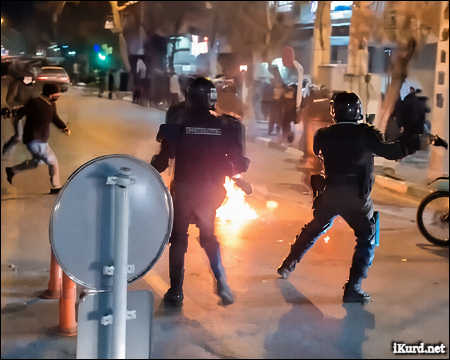
This military build-up directly intersects with events inside Iran. The recent protests that erupted across the country were primarily triggered by deep economic grievances, but they were later escalated and shaped by repeated warnings from Washington. When the U.S. President Donald Trump publicly cautioned Tehran on January 2, 4 and 9 against lethal crackdowns on demonstrators, urged Iranians to seize state institutions and amplified messages of support despite internet blackouts and mass arrests, many in Iran did not perceive those remarks as idle rhetoric. Instead, they interpreted them as backed by a willingness to act.

As Asia Times columnist Bahauddin Foizee notes, Trump’s record—from the dramatic capture of Venezuelan President Nicolás Maduro during Operation Absolute Resolve, to airstrikes on Iranian nuclear facilities in 2025, and the killing of figures such as Iranian Quds Force commander Qassem Soleimani in 2020 and ISIS leader Abu Bakr al-Baghdadi in 2019—“lent credibility to his words and encouraged citizens to protest despite the risks.”
Indeed, Trump’s follow-through actions have reinforced the perception that he can translate stated intentions and bold declarations, which might initially sound like mere rhetoric, into real consequences.
That is why, many Iranians, Foizee argues, interpreted Trump’s repeated warnings, combined with his demonstrated record of follow-through, as evidence that the U.S. was “capable of and willing to alter outcomes in real time.” That belief emboldened protesters, accelerating confrontations, leading to deaths or severe injuries among the protesters.
Risk of Disillusionment
However, Foizee warns that without meaningful U.S. follow-through, this confidence could quickly turn into disillusionment, discouraging future protests and undermining the U.S. credibility both inside Iran and among global partners.
Now, given U.S. openness to diplomacy, if the U.S. proceeds with a largely aerial campaign as a tool of diplomatic leverage rather than as part of a broader strategy to change the regime, the campaign risks being perceived as symbolic rather than transformative. Such limited action would likely prove insufficient to protect protesters’ aspirations, let alone compel genuine political change in Tehran. Without meaningful action against the regime in Tehran, the confidence many Iranians developed in Trump could quickly give way to disillusionment.
Foizee underscores this danger. With protests now suppressed and Tehran having reasserted control, the risks of judicial persecution is no longer hypothetical. There might be executions, life imprisonments and more if the regime survives.
In this circumstances, any U.S. action perceived as weak will result in disillusionment which, Foizee argues, may dampen future movements inside Iran, while confidence among U.S. allies and partners in Washington’s commitments could erode. The movements that once trusted U.S. backing may hesitate if they conclude that their risks will not be matched by U.S. resolve.

U.S. and Trump’s Credibility at Stake
For Trump, whose political brand rests on the assertion that “he means what he says,” this moment represents a defining test. If the U.S. seeks to uphold its global commitments and sustain the hopes of oppressed populations, a diplomatic approach, even if leveraged by an aerial campaign, will not suffice.
What is required is a decisive approach to bring about political change in Tehran. At this juncture, any U.S. approach, attempt or effort must translate into outcomes that decisively bring changes to the on-the-ground reality. Otherwise, the hard-won perception of U.S. resolve risks unravelling on the global stage.
For Iranians risking their lives in the streets, for global partners watching closely and for the credibility of the U.S. itself, the question is simple: can the U.S. armada turn the tables in Tehran, ensuring lasting protection for protesters who trusted a U.S. president, or will it limit itself to an aerial-only campaign like that of June 2025, leaving protesters at the mercy of the regime?
Syafruddin Arsyad is an independent researcher on the latest current affairs in the Middle East and their impacts on other regions of the world, including Southeast Asia. His has been writing for a decade now and has been published on many media-outlets including InDepth News (International Press Syndicate), OpEd Column Syndication, Foreign Policy News, Eurasia Review and Daily Times.
The opinions are those of the writer and do not necessarily represent the views of iKurd.net or its editors.
Copyright © 2026 iKurd.net. All rights reserved.
Related posts:
 The Resurrection (Ba’ath) Party – Before the Iran-Iraq War
 The Assassination of Abdurrahman Ghassemlou: No Friends but the Mullahs?
 Saddam Hussein was a Friend to the West
 The Suffocation of Iraq Kurdistan
 The Sun Also Rises in Western Iran
 Iran, a Failed Country by Enemies Within
 Iraq: Revenge and Corruption
 Iran – Toxic Theocracy – Part I
 Iran is Not Syria
 Iran Regime Change Vs. Map Change