


WASHINGTON,— U.S. President Donald Trump told Ukraine’s President Volodymyr Zelensky on Monday that Washington would help ensure Ukraine’s security in any eventual deal to end the conflict with Russia, though the scope of U.S. involvement remained unclear, officials said.
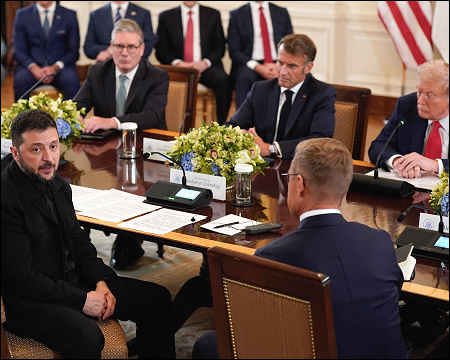
The commitment was made during a White House summit with Zelensky and leaders from several European nations.
The session came just days after Trump’s separate meeting with Russian President Vladimir Putin in Alaska, which included early discussions on possible steps toward a settlement, according to a senior U.S. administration official.
“On security, there will be significant assistance,” Trump said at the Oval Office. He emphasized that European countries were the “first line of defense” but said the U.S. would support them in backing Ukraine.
Zelensky described the promises as “a big move forward” and said Kyiv expected the commitments to be set down formally within 7 to 10 days. He added Ukraine was ready to purchase nearly $90 billion of U.S.-made weapons systems.
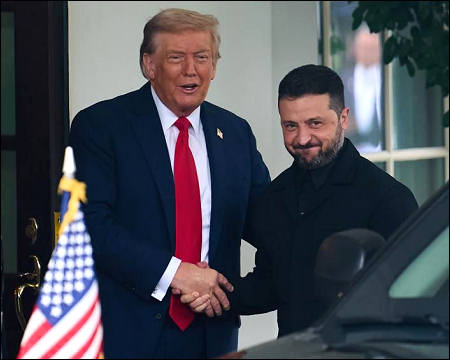
Monday’s tone was markedly different from Zelensky’s February meeting in Washington, when Trump and Vice President JD Vance openly criticized him. This time Zelensky received a warm welcome, including praise from Trump for his businesslike suit instead of his usual military-style outfit.
Asked about his message to Ukrainians, Trump replied: “We love them.” Zelensky thanked him repeatedly, striking a respectful note after previous tensions.
The Ukrainian leader also arrived with reinforcements. Heads of state and senior officials from Germany, France, Britain, Italy, Finland, NATO and the European Union joined the Washington session to underline collective backing for Kyiv.
Moscow has already rejected the idea of NATO forces being deployed to secure any settlement. The Russian Foreign Ministry said Monday such a step was unacceptable, limiting the reach of Trump’s offer.
Still, Trump and Zelensky both said they want to move toward direct talks with Putin. Trump later posted online that he had already spoken with the Russian leader about arranging a meeting between him and Zelensky, to be followed by a three-way summit.
European officials said Putin himself suggested that sequencing. German Chancellor Friedrich Merz told reporters that the Putin-Zelensky meeting could be held in Hungary within two weeks, though the Kremlin has not officially confirmed.
The last direct talks between Russia and Ukraine took place in June in Turkey, when Putin refused Zelensky’s request for a personal meeting and instead sent a lower-level delegation.
Kremlin aide Yuri Ushakov said in audio remarks that Trump and Putin had discussed elevating the level of participants in future contacts.
European governments used the Washington visit to push for a ceasefire before any political settlement talks. Macron said such a pause was essential. “When we speak of security guarantees, we are speaking of the security of the entire continent,” he told Trump.
Trump, however, took a different line. He said he supported the concept of a ceasefire in principle but warned that it might disadvantage one side strategically. “I wish they could stop,” he said. “But they can still work on peace while fighting continues.”
Putin’s envoy Kirill Dmitriev welcomed the U.S. summit but said the focus should be “lasting peace” rather than a short-term truce.
Trump has been pressing for a rapid end to what he has called Europe’s deadliest war since the mid-20th century. Some U.S. allies worry this means Kyiv may be asked to make territorial concessions that align with Russia’s terms.

At the Alaska talks, Putin proposed that Ukraine formally cede control of areas in eastern Donetsk still under Russian occupation. Zelensky rejected the idea, saying any such move would require a referendum.
Trump has publicly argued that Kyiv should abandon its efforts to regain Crimea, annexed by Russia in 2014, and also drop its pursuit of NATO membership.
More than one million people on both sides have been killed or wounded since Russia launched its full-scale invasion in 2022, analysts estimate, including thousands of Ukrainian civilians. Large areas of the country’s east and south remain in ruins.
Despite warmer optics at the White House, officials from both camps acknowledged that a final agreement remains elusive.
Territorial disputes, the question of NATO, and sequencing of talks continue to block progress even as Washington, Kyiv and European partners try to open new channels with Moscow.
(With files from Reuters)
Copyright © 2025 iKurd.net. All rights reserved
Related posts:
 What makes a good NATO ally? The Case of Turkey
 Trump calls Zelensky ‘a dictator’, tells him to act fast for peace or lose Ukraine
 Ukrainian forces gain ground in Russia’s Kursk region
 Did President Putin read Brezhnev’s book on Afghanistan prior to invading Ukraine?
 Trump and Zelensky clash at the White House over Ukraine war
 Trump, Putin fail to reach a deal to end Ukraine war
 Trump’s political games and Kurdish paths to autonomy in Rojava
 Indian PM Modi visits Ukraine, meets president Zelensky
 Trump, Putin meet in Alaska for talks to end Ukraine war
 Russia, U.S. agree to work on ending war in Ukraine