

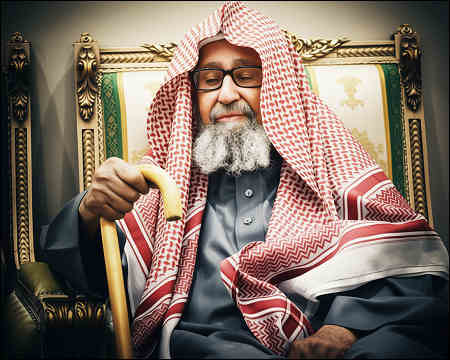
RIYADH,— Saudi Arabia has named Sheikh Saleh bin Fawzan al-Fawzan as its new grand mufti, the country’s top religious post, the Saudi Press Agency said on Wednesday night.
The appointment, approved by King Salman and proposed by Crown Prince Mohammed bin Salman, follows the death of Sheikh Abdulaziz bin Abdullah al-Sheikh in September, who had served in the role for about 25 years.
According to the agency, Sheikh Saleh, aged 90, was born in al-Qassim province in 1935. He began studying the Quran under a local imam after his father’s death and went on to become one of the most recognized scholars in the kingdom.
He gained prominence through radio and television appearances, including his regular program “Noor ala al-Darb,” meaning “Light the Way.” His religious rulings, or fatwas, have circulated widely on social media and in published works.
Human Rights Watch and other organizations have previously cited his controversial remarks, including statements about Shiite Muslims.
In a 2017 report, the group quoted Sheikh Saleh describing Shiite as “brothers of Satan” and saying there was “no doubt about their unbelief.” Such rhetoric has often reflected long-standing sectarian divisions in the region, particularly amid political strains between Riyadh and Tehran.
Sheikh Saleh has also condemned Yemen’s Houthi forces for missile attacks directed toward Islamic holy sites in the kingdom. Earlier in his career, he made comments linking slavery to Islamic tradition, stating in 2003 that it was “part of jihad.”
In 2016, he was linked to a fatwa labeling the game “Pokémon Go” as gambling. In later years, Saudi Arabia’s Public Investment Fund acquired large stakes in the companies that developed the game, Nintendo and Niantic.
The position of grand mufti has historically been held by members of the al-Sheikh family, descendants of Sheikh Mohammed Ibn Abdul-Wahhab, whose 18th-century religious teachings formed the basis of Saudi Arabia’s conservative interpretation of Islam.
The grand mufti serves as a leading authority for Sunni Muslims worldwide. Saudi Arabia’s influence stems from its role as the custodian of Mecca and Medina, Islam’s holiest cities, and its oversight of the annual Hajj pilgrimage.
Though the kingdom has introduced broad social and economic reforms under Crown Prince Mohammed, including steps to diversify away from oil dependence and loosen some social restrictions, religious authority continues to play a significant part in Saudi governance and identity.
(With files from AP)
Copyright © 2025 iKurd.net. All rights reserved
Related posts:
 The Resurrection (Ba’ath) Party – Before the Iran-Iraq War
 Stealing Syria
 Turkey: The Psychological War Against the Kurds Through the PKK – Part I
 Saudi Arabia to host 2034 FIFA World Cup
 Business with ISIS – Updated
 This is how the Saudis deal with bullies
 Iraq: Revenge and Corruption
 Trump meets Sharra, vows to lift sanctions on Syria
 Trump hosts Saudi crown prince Mohammed bin Salman at the White House
 LOSING IRAQ — to Iran