
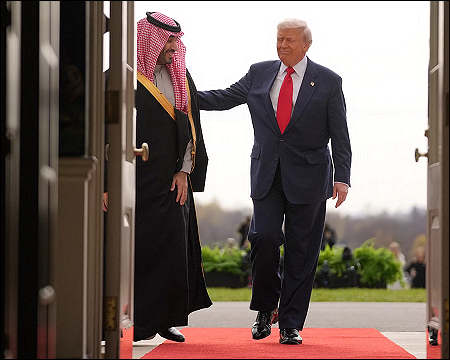
WASHINGTON,— U.S. President Donald Trump welcomed Saudi Crown Prince Mohammed bin Salman to the White House on Tuesday with a level of ceremony rarely seen during his administration.
The reception featured military honors, a red carpet across the South Lawn, and a flyover by American fighter aircraft. Trump praised the crown prince, commonly known as MBS, and said that relations between Washington and Riyadh were at their strongest in years.
Both governments entered the visit hoping to advance a set of major commercial plans and national security goals that have been in discussion for months.
The welcome ceremony began shortly after sunrise. U.S. service members lined the lawn while American and Saudi flags were placed along the driveway that leads to the executive mansion. Horses from the ceremonial unit stood nearby as the arrival procession formed.
Trump greeted the crown prince with a handshake at the White House entrance before the two turned their attention to the skies. A formation of F-35 and F-16 fighter jets passed overhead, signaling the start of the day’s meetings inside the Oval Office and the Cabinet Room.
Trump has for months underscored his desire to see Saudi Arabia and Israel take steps toward formal relations. He has repeatedly described an expanded version of his first-term Abraham Accords as a pillar of what he hopes will become a long-term vision for stability across the Middle East.
The fragile ceasefire in Gaza between Israel and Hamas has given the administration a renewed sense of urgency that an agreement involving Riyadh might be possible, though administration aides acknowledge that obstacles remain.
Speaking to reporters aboard Air Force One last week during a trip to Florida, Trump expressed confidence that Saudi Arabia would move closer to joining the accords. He told reporters that he hoped the kingdom would join the framework soon and suggested that conversations with regional leaders had made him more optimistic.
Still, several officials familiar with internal policy talks said Riyadh is unlikely to finalize any agreement in the near future.
Three administration officials, who spoke anonymously because they were not authorized to comment publicly, said a realistic timeline might extend into the end of Trump’s second term if progress can be maintained.
Earlier attempts under Trump’s first administration and then under President Joe Biden also fell short. King Salman had objected to joining the accords during Trump’s first term. After he stepped back from most policy decisions, Crown Prince Mohammed adopted a cautious approach following the Islamist Hamas attacks of Oct. 7, 2023, which initiated the Gaza conflict.
Trump on Tuesday rejected U.S. intelligence assessments suggesting Crown Prince Mohammed bin Salman may have played a role in the 2018 murder of Washington Post journalist Jamal Khashoggi.
Speaking in the Oval Office alongside the crown prince, Trump told reporters, “Whether you like him or didn’t like him, things happen. But (Prince Mohammed) knew nothing about it. And we can leave it at that. You don’t have to embarrass our guest by asking a question like that.”
While U.S. officials now believe the crown prince may be more flexible than in previous years, Riyadh continues to insist on a clear and credible path toward eventual Palestinian statehood. Israeli officials have resisted this condition, creating a significant barrier to any deal that would include Saudi normalization.
Trump has floated the idea that his twenty point Gaza peace plan could serve as the structure for such a path, though Israeli leaders have expressed concerns that any commitments tied to Palestinian statehood could weaken their security position.
One U.S. official said the most positive outcome for Washington this week might be getting the Saudis to acknowledge Trump’s plan as a basis for future talks and to state publicly that they are considering entry into the accords.
Trump has argued that broader dynamics in the region have shifted in ways that might support a deal. He has described Iran as weakened after years of conflict involving its partners in Gaza, Lebanon and Yemen, and pointed to U.S. military strikes in June that he said set back Tehran’s nuclear program.
According to Trump, those developments have created an environment in which Saudi Arabia and Israel might be more motivated to explore an agreement. He has also told supporters that if Saudi Arabia signs on, other Arab nations will follow.
Even so, the Saudi position that Palestinian statehood must be clearly outlined before any normalization remains a decisive factor.
Jonathan Schanzer, an analyst at the Foundation for Defense of Democracies, said images of destruction from the conflict continue to shape public opinion in Saudi Arabia. He noted that as long as scenes of devastation in Gaza are widely broadcast, the crown prince may find it difficult to advance normalization with Israel.
Progress in Gaza itself also remains uncertain. Israel and Hamas have been negotiating over the return of the final hostages. Several major decisions related to disarming Hamas, establishing security oversight in Gaza and shaping post-war governance have complicated the chances for lasting calm. Violence involving Israeli settlers in the West Bank has further undermined trust between regional actors.
For the White House, another sensitive topic relates to the crown prince’s interest in acquiring advanced American fighter aircraft. Saudi officials are expected to push for an agreement to purchase F-35 jets, among the most sophisticated in the world.
While the crown prince hopes to secure assurances on U.S. military protection and formalize a defense arrangement, senior administration officials said it appears unlikely that Trump will approve the aircraft sale at this time.
Concerns persist about maintaining Israel’s military edge and about risks that sensitive technology could be transferred to China, a country with close ties to both Saudi Arabia and the United Arab Emirates. The officials cautioned, however, that Trump has a record of unexpected decisions and could change his mind if he finds the Saudi arguments persuasive.
Analysts say the crown prince’s expectations for what he wants from Washington have grown since the beginning of the Gaza conflict.
John Hannah, a former national security adviser to Vice President Dick Cheney, said it would be unwise for Trump to move forward with the aircraft sales without linking them to normalization and broader regional security changes.
Hannah added that tying any future aircraft integration to a reorganized regional security framework would provide Washington needed leverage.
Later Tuesday, the crown prince attended a dinner that drew attention for its mix of political and high profile guests. Businessman Elon Musk joined Trump and MBS at the White House, marking another public appearance following a period of strained relations between Musk and the president.
Musk had supported Trump’s election last year and took on a senior role early in the administration, leading the Department of Government Efficiency. Their relationship soured after Musk publicly criticized a major tax and spending proposal and discussed forming a new political party.
Trump responded by threatening to withdraw federal subsidies from Musk’s companies, a dispute that analysts say damaged Tesla’s public image and stock performance. Their last notable encounter occurred in September at a memorial event for activist Charlie Kirk.
Also present at the dinner were Portuguese soccer star Cristiano Ronaldo and Nvidia chief executive Jensen Huang. Trump described it as an honor to host Ronaldo, who has become one of the faces of Saudi Arabia’s modernization drive through his role in the kingdom’s professional football league.
(With files from AP | Reuters | BBC | Agencies)
Copyright © 2025 iKurd.net. All rights reserved.
Related posts:
 Trump visits Saudi Arabia, holds talks with Crown Prince Mohammed bin Salman
 The Resurrection (Ba’ath) Party – Before the Iran-Iraq War
 Saddam Hussein was a Friend to the West
 Elon Musk leaves Trump administration
 Saudi Arabia to host 2034 FIFA World Cup
 Trump meets Sharra, vows to lift sanctions on Syria
 Elon Musk forms new ‘America Party’ in move into politics
 Internal Revolt Against Hamas in Gaza Was Already Underway
 Turkey: The Psychological War Against the Kurds Through the PKK – Part I
 Iraq comes full circle: The rehabilitation of Abd al-Karim Qasim