

US envoy Tom Barrack calls Damascus, Kurds agreement ‘historic milestone’
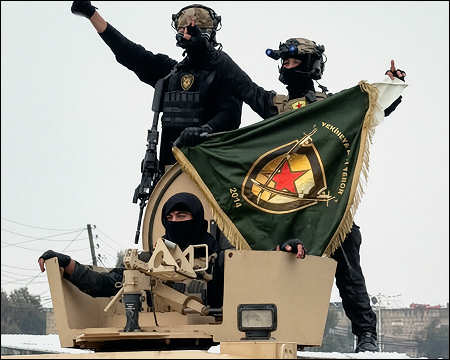
DAMASCUS,— Syria’s Islamist government and Kurdish forces of Syrian Kurdistan reached a comprehensive political and security agreement on Friday that sets out a gradual process to fold Kurdish armed units and civilian administration into the Syrian state, Syrian state television and Kurdish officials said.
The deal follows weeks of armed clashes between government forces and the Kurdish Syrian Democratic Forces SDF, which ended with a ceasefire.
During the fighting, Kurdish forces withdrew from areas they had controlled for years across northern and northeastern Syria.
As a result, Kurdish authority has now been limited largely to areas of Syrian Kurdistan (Rojava), a significant retreat from the territory they once governed during the country’s long civil war.
Details of the agreement were released by the SDF and broadcast on state media. The text says some Syrian government security forces will deploy in the northeastern Kurdish cities of Hasaka and Qamishlo, both under Kurdish control.
It also outlines the formation of three new Syrian army brigades made up of Kurdish SDF fighters.
In addition, a separate Kurdish brigade is to be established for the Kurdish town of Kobane in Aleppo province, an area that has held symbolic importance for Kurdish forces since early battles against Islamic State militants.
Damascus and the SDF agreed earlier this week to extend their ceasefire by 15 days while negotiations continue over the practical steps of integration.
Syria’s new Islamist authorities, who took power after the removal of longtime president Bashar al-Assad in December 2024, have made restoring state authority across the country a central goal.
Officials have said they aim to bring all armed groups under a single national command.
The agreement marks a setback for Kurdish ambitions for self-rule. During the 13-year conflict, Kurdish groups established a de facto autonomous administration in Western Kurdistan (Rojava Kurdistan), managing security, local councils, and public services independent of Damascus.
The governing model emphasized direct democracy, gender equality, secularism, and environmental sustainability, and it became widely known for expanding women’s participation in politics and local decision-making.
US envoy to Syria Tom Barrack welcomed on Friday the deal and described the agreement as a “historic milestone” in a post on X. He said it “reflected a shared effort to promote inclusion and bring Kurdish military and civilian institutions into the Syrian state framework.”
Political analyst Henase Karim told iKurd News that she is not optimistic, warning that implementing the agreement could be highly challenging, as Syrian government Islamist militias have a history of ignoring ceasefires, which could trigger renewed clashes.
She said the Syrian Islamist forces are not conventional military units but are made up of former ISIS and al-Qaeda fighters, making them unpredictable and highly dangerous.
Karim also expressed doubt that a significant number of Syrian government Islamist forces would enter Syrian Kurdistan, warning that if they do, it could spark further conflict.
(With files from AFP)
Copyright © 2026 iKurd.net. All rights reserved.
Related posts:
 Business with ISIS – Updated
 The Resurrection (Ba’ath) Party – Before the Iran-Iraq War
 The SDF–Damascus deal: A gamble over keys to Kurdish homeland
 The SDF–Syrian Regime Agreement: Context, Gains, and Ongoing Risks
 Syria: Revisiting The Caesar Torture Victim Photographs
 Sabotaging Syria
 Turkey: Nato’s Islamic State Member
 Syria: A ‘Caliphate’ by Any Other Name — Would Smell the Same
 Martyrs for Millionaires: The Black-Market Politics behind the Theft of Syria’s Oil
 Syria: The Hijacking of the Arab Spring: From ISIS to Hayat Tahrir al-Sham