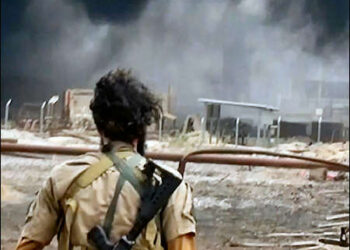


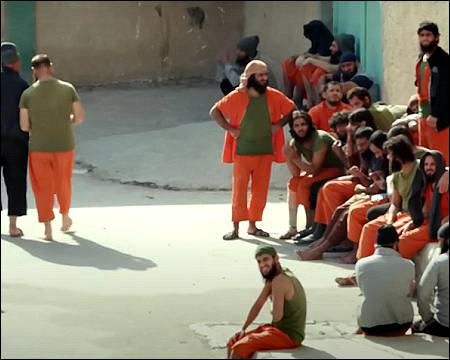
HASAKA,— The Syrian government Islamist militias’ advance into Kurdish-controlled areas has intensified fears over thousands of Islamic State detainees in northeast Syria. Western security observers warn that the current turmoil could allow prisoners to flee.
The Syrian Democratic Forces, or SDF, a Kurdish-led armed forces, led the campaign against IS with support from a U.S.-led coalition after the jihadist group declared a so-called caliphate in Syria and Iraq in 2014.
Since reclaiming the last pockets of IS-held territory nearly seven years ago, Kurdish authorities have held thousands of male Islamist fighters in prison and tens of thousands of women and children in camps across northeast Syria, many of whom are related to IS members.
Laurence Bindner, a radicalization expert, said these facilities have become “hotbeds of extremist activity.”
Three years ago, U.S. General Michael Kurilla warned that the detainees could form an “army in detention” in Syria and Iraq, posing serious threats if freed.
Al-Hol camp, the largest IS detention site in Syria, accommodates over 24,000 people, according to the camp director who spoke with AFP in December.
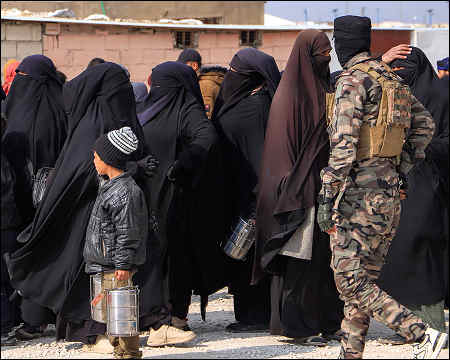
Syrians number about 15,000, Iraqis 3,500, and other foreigners 6,200. Foreign women and children are confined in a separate high-security zone.
Kurdish forces withdrew from Al-Hol on Tuesday to defend their Kurdish cities, and the Syrian army entered the camp the following day, preceding a newly announced ceasefire. The truce may pave the way for talks on integrating the Kurdish administration in Syrian Kurdistan (Rojava) and its forces into Syria’s government.
The Kurds have repeatedly asked countries to repatriate their citizens from detention. Baghdad has increased the pace of returns, while Western nations have allowed only limited numbers, citing the risk of attacks, including the 2015 Paris killings of 130 civilians.
A Western security source told AFP that events in Syria are “developing rapidly” and officials are “evaluating potential effects on the camps.” The source warned, “We cannot rule out escapes,” prior to the army’s takeover of Al-Hol.
Earlier this week, the Syrian Islamist army reported that IS detainees were released from a prison in the northeastern town of Shadadi, while Kurdish forces said they had lost control of the facility following an attack by Damascus militias.
Thomas Renard, research director at the International Centre for Counter-Terrorism in The Hague, said any mass escape would be “catastrophic,” whether through security gaps or deliberate releases.
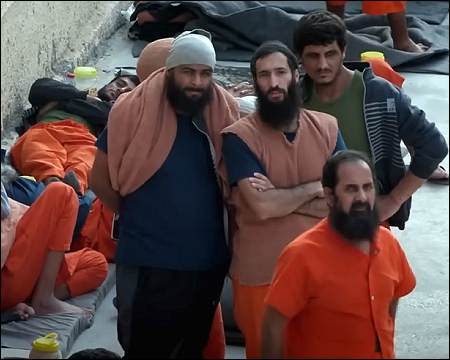
He called the system of provisional detention without trials “unsustainable” in such an unstable region.
Renard added that some escapees might attempt to stay hidden, but others could rejoin IS or allied jihadist groups, threatening Syria, the region, and global security.
Western intelligence sources have said IS still seeks to free imprisoned fighters. Bindner said pro-IS social media is active with questions about detainees’ fate.
“For IS, this situation presents a clear opportunity to exploit,” she said. Even a few dozen or hundreds escaping could strengthen morale and insurgent activity.
U.S. statistics from June indicate that around 2,000 IS suspects and an estimated 8,000 women and children held in northeast Syria are foreign nationals, including Shamima Begum, a former U.K. citizen who joined IS as a teenager.

Lilla Schumicky-Logan, joint director of GCERF, a global anti-extremism fund, noted there has been no thorough evaluation of how radicalized detainees are in Syrian prisons and camps.
Many foreign women have expressed remorse and requested repatriation.
She added that male prisoners have been detained for six to seven years and are often sick, weak, and some have tuberculosis. “We need to consider how capable they are of taking up arms again,” she said.
Ahmed al-Sharaa, also known as Abu Mohammed al-Golani, is serving as Syria’s interim president. He was one of the leaders of ISIS and later became a leading figure within al-Qaeda before founding the al-Nusra Front, which was initially aligned with al-Qaeda and later rebranded as Hayat Tahrir al-Sham (HTS).
(With files from AFP)
Copyright © 2026 iKurd.net. All rights reserved.
Related posts:
 Business with ISIS – Updated
 Syria: Revisiting The Caesar Torture Victim Photographs
 Syria: The Triumph of Terrorism
 Sabotaging Syria
 The Resurrection (Ba’ath) Party – Before the Iran-Iraq War
 Turkey: Nato’s Islamic State Member
 Syria: A ‘Caliphate’ by Any Other Name — Would Smell the Same
 Syria: The Hijacking of the Arab Spring: From ISIS to Hayat Tahrir al-Sham
 Syria: The Truth Lies Buried beneath an Edifice of Lies
 US begins transfer of Islamic State prisoners from Syria to Iraq