

Syria, Kurds still disagree on force merger, US envoy says
DAMASCUS,— Syria on Wednesday reaffirmed its opposition to federalism following talks with a top Kurdish military figure and reiterated its call for Kurdish fighters to merge with the national armed forces.
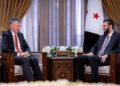
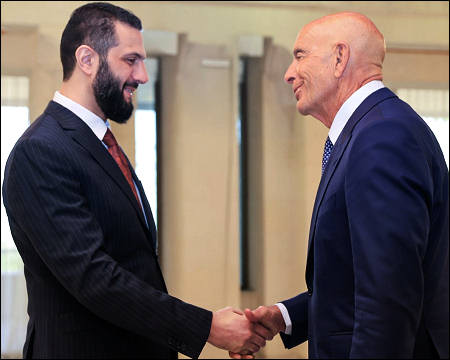
Gen. Mazloum Abdi, the commander-in-chief of the U.S.-backed Syrian Democratic Forces (SDF), held talks in Damascus with interim President Ahmed al-Sharaa to revisit a stalled agreement initially reached in March. A U.S. envoy also attended the meeting, which focused on efforts to unify the Kurdish-led administration in Syrian Kurdistan (Rojava) with the central government.
The Kurdish administration, which governs a large swath of northern Syria, including key oil and gas reserves, has long pushed for a decentralized system of governance. Damascus has consistently rejected any such proposals.
A Kurdish official, speaking anonymously due to the sensitivity of the matter, confirmed the meeting between Abdi and Sharaa took place Wednesday. U.S. Ambassador to Turkey and Special Envoy for Syria Tom Barrack was also present, the official said.
The discussions addressed political, economic, and military matters, particularly the status of the Autonomous Administration and its forces in relation to the Syrian state.
“The Syrian Army remains the unifying force of the nation,” a government source told state-run Alekhbariah TV. “We welcome the integration of SDF fighters into our military structure under constitutional and legal guidelines, but we categorically reject federalism or any form of division.”

The source added that delays in integration could negatively impact efforts to reestablish nationwide security and stability.
The SDF played a leading role in ousting the Islamic State group from Syrian territory, working closely with the United States and coalition forces.
Barrack told the Associated Press after Wednesday’s talks in Damascus that key disagreements remain between the Kurdish-led administration and the Syrian government. “It’s still a big issue,” he said.
Barrack said that he does not expect an immediate breakthrough. “These processes take time,” he added, “progress happens in small steps because it depends on trust, commitment, and understanding.”
Barrack expressed Washington’s full confidence in the Syrian government and its military. He described the Syrian Democratic Forces as a “valuable partner” in the fight against the Islamic State group and said the U.S. aims to ensure that the SDF can integrate into the new government respectfully.
The United States has started reducing its military presence in Syria, where roughly 1,300 troops remain deployed. However, Ambassador Tom Barrack said Washington is in “no hurry” to withdraw its forces entirely.
In a recent interview with Kurdistan 24, Ambassador Barrack acknowledged the SDF’s contributions in fighting ISIS but said the long-term political reality required reintegration into the Syrian state. “Their future lies in Damascus,” he said.
Sharaa, also known as Abu Mohammed al-Golani, took office following the fall of Bashar al-Assad after more than a decade of civil war and has called for the disbanding of all non-state armed groups.
In May, Gen. Abdi reiterated his vision for a decentralized Syrian system that ensures equal rights for all groups. He criticized the new Damascus leadership for opposing that framework.
Also in May, Syrian Foreign Minister Asaad al-Shaibani warned that further delay in the SDF’s integration could lead to increased foreign influence and ignite separatist sentiments.
The Kurdish-led Autonomous Administration, officially founded in 2018, operates under a system inspired by democratic confederalism. Its governance model includes direct democracy, secularism, gender equality, and environmental policy.
Under local laws in Syrian Kurdistan promoting gender equality, Kurdish women are required to serve in military forces — a policy that mirrors conscription practices seen in countries like Israel. Women currently occupy nearly half the roles in military, political, and civil sectors across the region.
Over the past decade, thousands of Kurdish women gave their lives fighting against the Islamic State group, often leading the frontline battles in Raqqa, Deir ez-Zor, and Kobani. Their sacrifice stands in direct opposition to the ideology of the Islamist factions now operating inside the Syrian army, where female fighters are neither accepted nor respected.
(With files from AFP | AP)
Copyright © 2025 iKurd.net. All rights reserved
Related posts:
 The Resurrection (Ba’ath) Party – Before the Iran-Iraq War
 Syria: A ‘Caliphate’ by Any Other Name — Would Smell the Same
 Betrayal by the Rogue State of America – The Bull in the China Shop
 Business with ISIS – Updated
 Stealing Syria
 Syria: Revisiting The Caesar Torture Victim Photographs
 The Islamic State of Syria? (Al Dawla al-Islamiya fi al-Sham)
 How the end of PKK impacts the SDF, and why Syria’s decentralization isn’t division
 Syria: The Truth Lies Buried beneath an Edifice of Lies
 Sabotaging Syria