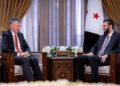



ANKARA,— Syria’s Foreign Minister Asaad al-Shaibani warned on Monday that delays in executing a recently signed integration deal between the Syrian transitional Islamist administration and Kurdish-led forces of Syrian Kurdistan could extend instability and encourage further fragmentation in the war-torn country.
Speaking at a joint press conference in Ankara with his Turkish and Jordanian counterparts, Shaibani described the agreement as a “pivotal development” that must be implemented without delay.
“Any postponement in implementing this national accord will only prolong the chaos, increase the risk of foreign intervention, and give momentum to separatist agendas,” he said.
The deal in question was signed in March 2025 between Syria’s interim President Ahmed al-Sharaa, also known by the name Abu Mohammed al-Golani, and Syrian Democratic Forces (SDF) commander-in-chief General Mazloum Abdi.
The agreement outlines a framework for incorporating the civil administration and military structures of the Kurdish-led Autonomous Administration of North and East Syria into the centralized Syrian government.
The signing came roughly three months after the ouster of longtime leader Bashar al-Assad, marking a transitional moment in Syria’s political landscape.
“This process is undoubtedly complex and requires careful steps,” Shaibani said, “but it is essential. Our goal is not dominance—it is national reunification under one state. We are fully committed to this agreement and expect reciprocal dedication from the SDF leadership.”
Shaibani’s remarks followed the unexpected announcement by the Kurdistan Workers’ Party (PKK) that it would disband.
While the SDF claims operational independence from the PKK, many of its senior ranks are affiliated with the YPG (People’s Protection Units), a group that Turkey regards as the PKK’s Syrian extension.
Mazloum Abdi, in a statement on the social media platform X, welcomed the PKK’s move and called it a “constructive and strategic decision.” He said the step “will open the door to a new phase of politics and reconciliation in the region.”
In February, Abdi had addressed earlier appeals for the PKK to disarm and dissolve, stating at the time that such initiatives were “not concern the SDF.”
His comments had aimed to clarify that the SDF’s structure and objectives remained separate from those of the PKK, particularly in response to criticism from Ankara.
The Kurdish administration and its de facto army the SDF control a broad stretch of territory in Syrian Kurdistan (Rojava), including key oil and gas reserves. The area—centered around the Kurdish cities like Qamishlo, Hasaka, and parts of Deir ez-Zor—has operated semi-autonomously since the early years of the Syrian civil war, which began in 2011.
Backed by the United States, the SDF played a major role in combatting the Islamic State group. The coalition was instrumental in dismantling the last ISIS stronghold in Syria in 2019, reinforcing the SDF’s status as a major force in the region.
Despite military cooperation with international actors, Kurdish political leaders have voiced dissatisfaction with the transitional framework introduced in March by the new Islamist transitional government in Damascus.
They argue that the temporary constitutional declaration falls short of representing the country’s ethnic and political diversity.
The Autonomous Administration, formally established in 2018, governs the region based on principles of democratic confederalism. The model emphasizes direct democracy, gender equality, secularism, and environmental sustainability. It has been widely recognized for advancing women’s participation in politics and local decision-making.
Addressing these concerns, Shaibani stated that the rights of all Syrian citizens, including Kurds, would be preserved. “Syria is a unified and sovereign state. That principle is non-negotiable,” he said.
“Kurdish citizens will be treated equally under Syrian law, and their cultural and political rights will be safeguarded within the framework of national unity.”
While Damascus insists the deal with the SDF is part of national reconciliation, analysts caution that control over oil-rich areas, governance authority, and regional loyalties could continue to challenge the integration process in the months ahead.
Implementation of the agreement is expected to begin before the end of 2025, although concrete steps remain unclear.
(With files from AFP | Agencies)
Copyright © 2025 iKurd.net. All rights reserved
Related posts:
 Business with ISIS – Updated
 Syria: A ‘Caliphate’ by Any Other Name — Would Smell the Same
 Turkey: The Psychological War Against the Kurds Through the PKK – Part I
 Stealing Syria
 Sabotaging Syria
 The PKK’s Personality Cult: Changing Influences – Part II
 What makes a good NATO ally? The Case of Turkey
 Syria: Revisiting The Caesar Torture Victim Photographs
 Syria: The Hijacking of the Arab Spring: From ISIS to Hayat Tahrir al-Sham
 The Resurrection (Ba’ath) Party – Before the Iran-Iraq War