


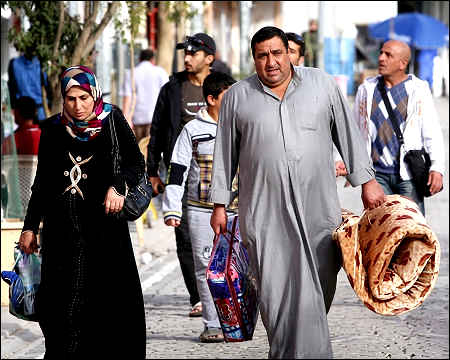
The Arabization of Iraq’s Kurdistan Region?! – Part IV
Salih Zhajlayi | Exclusive to iKurd.net
Translated by iKurd.net from Kurdish Awene
Some comments on Kak Rebin Herdi’s writing under the title: “Is There a Danger of Arabization?”
In the third part of this topic, I especially expressed my own opinion regarding the writing of my brother Kak Rebin Herdi. However, there are still many other points that I want to discuss in this part and explain more clearly.
Kak Rebin says in the sixth point of his article:
“The arrival of Arab citizens in the way it is happening today, without a planned policy from the central government behind it, is not only natural and does not lead to Arabization, but there is even a possibility that those people could become Kurdistanized, just like the migration of millions of Kurds to European cities, where they all became citizens of those countries, rather than making those European cities Kurdish.”
Indeed, if a complete book were written only about this opinion of Kak Rebin, it still would not reach a complete conclusion, because this is a very broad topic that can be analyzed from many different perspectives.
The migration of Kurds to European countries and their becoming citizens of those countries is very different from Arab citizens coming to Kurdistan and settling there.
European countries are each independent. The borders of those countries are defined and protected according to international law.
Therefore, even if citizens of other countries around the world go to any of these European countries, they do not become a danger. In the end, they either have to become citizens of those countries or remain there as guests.
However, the Kurdistan Region is not an independent state; it is part of Iraq. According to the law, Arab citizens also have the right to settle in the Kurdistan Region and consider it their own country.
But the question is this: In Iraq, are Kurdish citizens equal to Arab citizens?
Is it not clear before everyone’s eyes that in Kirkuk, Kurds are being removed from their own homeland, while Kirkuk is originally part of the Kurdistan Region?
Well, does anything like this happen in any European country?
You can see the process of Arabization happening with your own eyes every day, and it has continued from the establishment of the Iraqi state until today. The Arabization of the Kurdistan Region is also an inseparable part of this Arabization process.
So how can the arrival of such a large number of Arabs in large waves to the Kurdistan Region not be considered a danger and still be considered natural, and how can it be compared to the migration of Kurds to Europe and their settlement there?
Kak Rebin says that the arrival of Arab citizens is not a danger if there is no planned government policy behind it.
I say: Yes, there is a planned policy by the Iraqi government and other Arab countries behind it, under the cover of Islam and through political Islamic parties that are against the Kurds. This has secretly been put into practice for a long time.
After the 1991 uprising, Gulf countries, through the Islamic Union, tried to spread the ideology of the Muslim Brotherhood in the Kurdistan Region.
Well, isn’t this a plan?
The Islamic parties have also damaged the relationships among Muslim citizens of the Kurdistan Region, and today they have become opponents of each other.
Isn’t this a program?
Have you forgotten when Afrin was occupied and Kurds were displaced? With money from Qatar, camps were being built for imported Arabs on Kurdish land.
Well, do you not ask what Qatar’s hostility toward the Kurds is?
Does this mean that all Arabs are against Kurds?
Let us say that it was Saddam Hussein’s plan to force Arab citizens to settle in Kurdish areas, and that this happened by force.
But Saddam Hussein no longer exists. Why do those Arabs not return to their original lands?

Is it reasonable that Kurds fought in 1961 over Kirkuk, Khanaqin, Jalawla, and Shengal, and now they should wash their hands of these places and prepare the ground so that Sulaimani, Erbil, and Duhok also become Arabized?
Should we accept that, for the benefit of some unpatriotic officials and greedy businessmen, Arabs can come in large numbers and settle in the Kurdistan Region as if it were something normal?
How can you and I, who witnessed the era of the Anfal campaign, the chemical attack on Halabja, and many other tragedies in Kurdistan, who either experienced them ourselves or saw those tragedies with our own eyes, now come and make excuses for settling Arabs in the heart of our homeland and consider this something normal and natural?
A very important point that I want to mention is this:
What Saddam tried to do against the Kurds for many years, he was not able to achieve. But in the end, the Kurds themselves did it against themselves.
First: The forced expansion of the Arabization process. However, today Kurds themselves are expanding it voluntarily.
Second: In 1978, Saddam moved villagers living along the border areas several kilometers deep into other areas so that the Peshmerga forces would no longer have places to stay.
But instead of Kurdish authorities trying to rebuild all of those villages and support the farmers, the Patriotic Union of Kurdistan and the Kurdistan Democratic Party, while fighting each other, turned every young person they could find into police and security forces. As a result, the villages became empty.
If people were forced to leave their homes in the past, they would return to the villages and mountains.
But today, areas such as all of Garmiyan, Chamchamal, and many other areas have been emptied. We no longer have geographical depth where we can find shelter and retreat during times of attack.
The enemies of the Kurds are also continuously working through Islam to wash people’s brains.
We have religious clerics who freely speak through microphones and threaten those who talk about the dishdasha, saying: “Speaking negatively about the dishdasha is a red line.”
Meaning, if someone says that the dishdasha is bad, they will cut his tongue, and there is no one who dares to say even a single word against them.
Well, isn’t this a planned program under a hidden cover to Arabize the Kurdistan Region?
A real estate office owner says:

“I am proud of myself for selling property to Arab citizens because I do not make any distinction.”
But why do those Arabs who come to Kurdistan not wear Kurdish shalwar instead of the dishdasha and learn the Kurdish language?
Is this really something normal and natural?
Well, why does Qatar provide money to the Islamic Union to build mosques, but does not tell them to build schools?
Is it acceptable that 5,000 people in the city of Halabja were killed by chemical attacks, and now there is a program to make girls wear head coverings from childhood and wash their minds?
Do you think this is all happening by coincidence and without a plan?
Kak Rebin compares the migration of Arab citizens from central and southern Iraq to the Kurdistan Region with the migration of Kurdish citizens to European countries.
Even if that comparison were true, the large-scale migration of Kurds and other people from around the world to Europe is not without problems or difficulties, and those countries are not happy about this large wave of migration either.
The reasons that caused citizens of other countries to migrate to Western European countries were the following:
First: In the past, Western countries and the former Soviet Union had conflicts and were against each other. Therefore, anyone who migrated from the Eastern Bloc to the Western Bloc was accepted.
Second: Many times, they needed workers, and they accepted young people so they could work in their factories.
Third: In recent years, as a result of wars between countries around the world, people have moved in large numbers toward European countries.
Examples include the wars of the Arab Spring, the conflict between the United States and Iran, the war in Afghanistan, and the war between Russia and Ukraine.
There was also the migration of one million people at once from Syria to Germany.
Because these migrations were not normal, natural, or based on a planned process, Europe’s situation became very difficult, and today European countries are facing financial and economic problems.
Above all, there is the danger to national security.
The people who moved toward European countries do not share the same culture as those countries. Refugees have gained a negative image in the eyes of many people in those countries. They are viewed as a problem because many of them do not work and live at the expense of those societies.
The issue of separation between husbands and wives among refugee communities has become one of the sources of many problems.
The large number of refugees in those countries has changed the appearance of their cities.
A city like London, which was built more than two thousand years ago and was one of the most beautiful and magnificent cities in the world, has had its beauty damaged because of the large number of refugees.
If you visit central London today, it is rare to see an English person. However, in the blink of an eye, you can see hundreds of people wearing turbans, women wearing head coverings and veils, and men wearing dishdashas and agals.
Many neighborhoods in central London no longer have a single English person.
This phenomenon exists in many European cities and continues to increase. Today, many countries are working on decisions to prevent women wearing face coverings or full veils from entering markets or workplaces.
To bring this discussion to an end, I live in Sweden, in the city of Gothenburg, which is the second-largest city in Sweden.
Four large neighborhoods have been created, with tens of thousands of people living in them, where it is rare to see a Swedish person.
When you go to those neighborhoods, you feel as if you are living in Somalia or another African country.
The gathering of all these foreign people in those neighborhoods, while maintaining the same culture of their own countries, does not mean that they become Swedish citizens in terms of integration. Instead, they are also changing the demographics of the cities.
Worse than all of this, hundreds of gangs involved in theft, fraud, drug dealing, and smuggling have been created, and shootings and killings happen every day.
Only in this city where I live, nearly 20 Kurds have killed each other in conflicts related to drug dealing, and a number of others are in prison.
Unfortunately for us Kurds, the leader of the drug-dealing gangs is also Kurdish.
This situation exists among many other nations as well.
Therefore, today being a refugee is a very difficult issue, and most political parties, during election periods, turn opposition to refugee arrivals into a slogan and a program in order to gain more votes.
Therefore, from now on, it cannot be expected that refugees who go to European countries can easily integrate into those societies, and that the people of those countries will immediately see them as their own citizens.
I brought these examples because I do not want Kak Rebin to think that the migration of Kurdish citizens or other nations to Europe is something completely normal, and that as soon as they arrive, they immediately become part of the citizens of those countries.
If this is the situation in Europe, then how can it be expected that the arrival of large numbers of Arab citizens to the Kurdistan Region is something normal and natural, and that later all of them will become citizens of Kurdistan and the Kurdistan Region will become a respected and honorable place?
A person can only imagine such a thing in a dream.
In the end, I ask you to read the article by the respected Dr. Siwayli, which he wrote to the Prime Minister regarding the large number of Arabs in the city of Erbil.
In one part, he says:
“In the city of Erbil, among the young people inside the city, thirty percent of the residents are Arabs.”
Unfortunately, the high-ranking officials of the government, because they are busy making themselves wealthy, are no longer aware of what is happening inside their own home and what dangers they have created the conditions for themselves through their own actions.
Therefore, in my opinion, any person or group that, under any excuse, creates the conditions for or gives legitimacy to the arrival of Arabs and their settlement in the Kurdistan Region is directly becoming an enemy of the Kurds.
Salih Zhajlayi, one of the political figures in Sulaimani city, Iraqi Kurdistan, and formerly the Deputy Head of the General Assembly of the Gorran (Change) Movement, is currently working independently in Sulaimani.
This article was originally published in the Kurdish language in Awene Newspaper on July 31, 2026.
The opinions are those of the writer and do not necessarily represent the views of iKurd.net or its editors.
Copyright © 2026 iKurd.net. All rights reserved.
Related posts:
 Who’s Really Arabizing Kurdistan? It’s Not Baghdad – Part III
 Who’s Really Arabizing Kurdistan? It’s Not Baghdad – Part V
 Who’s Really Arabizing Kurdistan? It’s Not Baghdad – Part I
 The Resurrection (Ba’ath) Party – Before the Iran-Iraq War
 Land Distribution in Kurdistan Is an Unforgivable Crime
 The Kurds Between the Holocaust and the Arab Conscience
 What makes a good NATO ally? The Case of Turkey
 Who’s Really Arabizing Kurdistan? It’s Not Baghdad – Part II
 Behind the Veil of Turkey’s ‘Zero Problem’ Policy – A Kurdish Perspective
 Anfal – The Black Stain on Iraqi History Spreads