

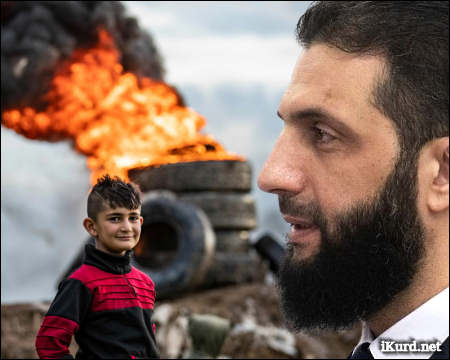
DAMASCUS,— Syria’s interim president Ahmed al-Sharaa has ruled out adding the Kurdish New Year festival, Newroz, to the country’s list of official holidays, according to a statement released Sunday by the presidency.
Instead, March 21 will remain observed as Mother’s Day, despite repeated calls from Kurdish representatives for the celebration to be formally recognized.
The announcement came as members of Syria’s first parliament since the fall of Bashar al-Assad were selected. Kurdish and Druze communities were excluded from the new body, which is dominated by Sharaa’s allies.
Kurdish officials in Syrian Kurdistan condemned the process, describing it as undemocratic and designed to strengthen the interim leader’s authority.
Newroz marks the beginning of spring and is a key cultural event for Kurds. The 2025 observance corresponds to the year 2725 in the Kurdish calendar, which dates back to 612 BC, when Cyaxares of the Median Empire seized Nineveh, ending Assyrian dominance.
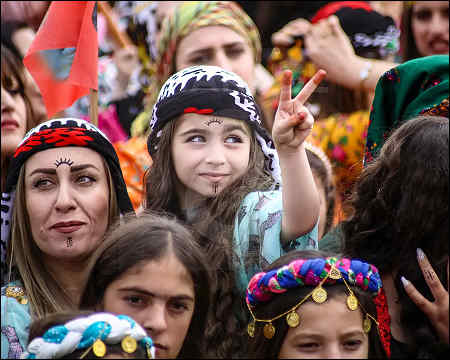
It is celebrated across Iraqi Kurdistan (Bashur), as well as in Turkey Kurdistan (Bakur), Iranian Kurdistan (Rojhelat) and Syrian Kurdistan (Rojava), and by Kurdish communities abroad.
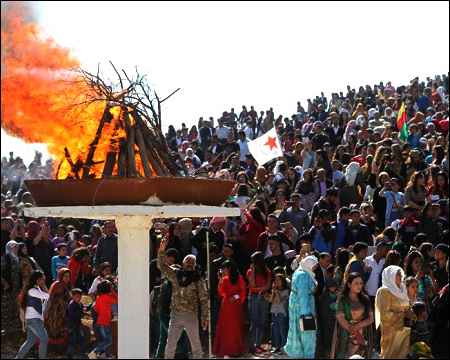
Traditional customs include bonfires on mountainsides and large outdoor gatherings that symbolize renewal and resistance.
Kurds are estimated to make up more than 3 million people in Syrian Kurdistan, accounting for roughly a tenth of Syria’s population. Kurdish leaders have long sought greater political participation and recognition of cultural traditions, including Newroz.
The Islamist-led interim government has confirmed that Syria will observe 13 public holidays, including Islamic festivals such as Eid al-Fitr and Eid al-Adha, along with a new day in December marking Assad’s ouster.
Authorities have pledged to uphold minority rights, with international agencies linking future sanctions relief to inclusive governance. Critics, however, argue that recent steps show exclusion rather than integration.
Sharaa, who has also been known as Abu Mohammed al-Golani, has a past with extremist Islamist movements. He was previously linked to al-Qaeda and ISIS before creating the al-Nusra Front, which later rebranded as Hayat Tahrir al-Sham.
In March 2025, the Kurdish-led Syrian Democratic Forces (SDF) signed an agreement with Damascus to join state institutions after more than a decade of war.
The deal envisioned Kurdish-led administrations and fighters becoming part of national structures, though details remain unresolved. The SDF wants its forces to be integrated as a bloc, while Damascus insists they join individually.
The Autonomous Administration in Syrian Kurdistan, established in 2018, has urged amendments to the interim constitution adopted in March. A communique from Kurdish officials said the document “does not reflect the aspirations of the Syrian people” and called for revisions to ensure fair representation during the transitional period.
The SDF continues to accuse pro-government factions of carrying out attacks in Syrian Kurdistan, complicating reconciliation efforts.
The Kurdish-led administration has promoted democratic confederalism, emphasizing gender equality, local councils and secular governance. Its system has drawn attention abroad for increasing women’s participation in politics.
Observers say the refusal to recognize Newroz is likely to deepen Kurdish grievances and add to mistrust between the interim authorities and the Kurds, undermining efforts to stabilize Syria during a fragile transition.
(With files from Agencies)
Copyright © 2025 iKurd.net. All rights reserved
Related posts:
 Stealing Syria
 The Resurrection (Ba’ath) Party – Before the Iran-Iraq War
 Newroz And The Attempts of Cultural Appropriation
 The SDF–Damascus deal: A gamble over keys to Kurdish homeland
 The Islamic State of Syria? (Al Dawla al-Islamiya fi al-Sham)
 Turkey: The Psychological War Against the Kurds Through the PKK – Part I
 Syria: Revisiting The Caesar Torture Victim Photographs
 Syria: A ‘Caliphate’ by Any Other Name — Would Smell the Same
 Syria’s Sharra symbolically declares Kurdish a “national language”, seen as “political game”
 Syria: The Hijacking of the Arab Spring: From ISIS to Hayat Tahrir al-Sham