

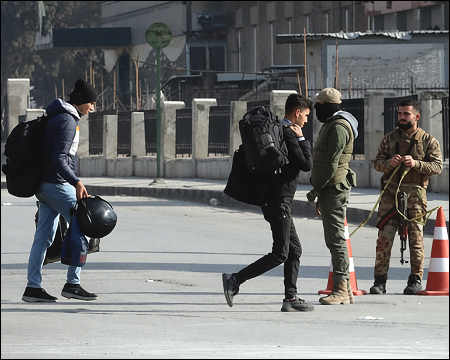
ALEPPO,— Syria’s defense ministry announced a ceasefire on Friday in Aleppo after days of intense clashes between government Islamist militias and Kurdish fighters forced thousands of civilian Kurds to flee, according to state media.
The fighting, which has killed at least 21 people, represents the deadliest outbreak of violence since Islamist authorities assumed power in Aleppo over a year ago.
Government-aligned jihadi forces have been battling the U.S.-backed, Kurdish-led Syrian Democratic Forces (SDF) in Syria’s second-largest city since Tuesday.
Both sides have blamed each other for starting the fighting. The clashes come amid stalled negotiations over a deal intended to merge Kurdish administration in Syrian Kurdistan (Rojava) and the Kurdish forces structures into the Syrian government framework.
The SDF, the de facto army of Syrian Kurdistan, which controls large areas in Syria’s oil-rich north and northeast, was instrumental in defeating the Islamic State group in Syria in 2019.
“To avoid further fighting in residential areas, the Ministry of Defense said a ceasefire will take effect at 3:00 a.m. in the Aleppo neighborhoods of Sheikh Maqsud, Ashrafiyeh, and Bani Zeid,” the ministry stated. Kurdish forces were given until 9:00 a.m. Friday to withdraw from the specified Kurdish areas.
The ministry added that the ceasefire aims to allow civilians displaced by the fighting to return to their homes and resume daily life in an atmosphere of security and stability.
Aleppo Governor Azzam Algharib told the state-run SANA news agency that he inspected the security arrangements in the Ashrafiyeh neighborhood. There was no immediate response from Kurdish officials regarding the ceasefire announcement.
The fierce clashes across the Kurdish-majority districts of Ashrafiyeh and Sheikh Maqsud continuing into Thursday night.
Syria’s military had warned civilians to leave via humanitarian corridors before launching the operation. State media said about 16,000 people had fled the areas.
SDF leader, General Mazloum Abdi criticized the attacks, saying assaults on Kurdish neighborhoods undermine efforts to reach political understandings.
Abdi had visited Damascus earlier this week for talks on a March integration agreement that has been stalled by disagreements, including Kurdish demands for decentralized governance.
US envoy calls for ceasefire in Aleppo amid deadly clashes
The United States’ special envoy to Syria on Friday warmly welcomed the temporary ceasefire achieved in Aleppo and called on both the Syrian army and Kurdish forces to halt fighting.
Tom Barrack issued an urgent appeal through X, urging the Syrian government, the Syrian Democratic Forces, local authorities in Kurdish-administered areas, and all armed groups on the ground to immediately pause hostilities and reduce tensions.
Barrack stressed that all sides should commit to de-escalation and exercise the “utmost restraint” to prevent further civilian casualties.
Despite an agreement in April for Kurdish SDF fighters to withdraw, Sheikh Maqsud and Ashrafiyeh have remained under the control of Kurdish security forces, who protect civilians from attacks by government militias.
Analyst Aron Lund of the Century International Research Center told AFP that Aleppo is “the SDF’s most vulnerable area” and that both sides are applying pressure to rally international support.
He warned that escalating hostilities could lead to a full Damascus-SDF confrontation across northern Syria, potentially drawing in Turkish and Israeli involvement, further destabilizing the country.
Protests against the Aleppo violence erupted in Kurdish areas. In Qamishlo, hundreds rallied, calling on the international community to intervene. “No to war,” said protester Salaheddin Sheikhmous, 61.
Similar demonstrations took place in the main Kurdish city of Amed (Diyarbakir), Turkey Kurdistan.
The Autonomous Administration, established in 2018, governs Syrian Kurdistan under democratic confederalism, promoting gender equality, secularism, and local decision-making. The system has been praised for advancing women’s political participation and community governance.
(With files from AFP | Agencies)
Copyright © 2026 iKurd.net. All rights reserved.
Related posts:
 Sabotaging Syria
 Business with ISIS – Updated
 Damascus, Kurdish SDF agree to de-escalate after Aleppo clashes
 Syrian government militias shell Kurdish areas in Aleppo after civilians flee
 Syria bombs Kurdish neighborhoods in Aleppo city
 Kurdish fighters refuse to pull out of Syria’s Aleppo after truce
 The Resurrection (Ba’ath) Party – Before the Iran-Iraq War
 Kurdish fighters agree to leave Syria’s Aleppo after deadly clashes
 Syria: A ‘Caliphate’ by Any Other Name — Would Smell the Same
 The SDF–Syrian Regime Agreement: Context, Gains, and Ongoing Risks