

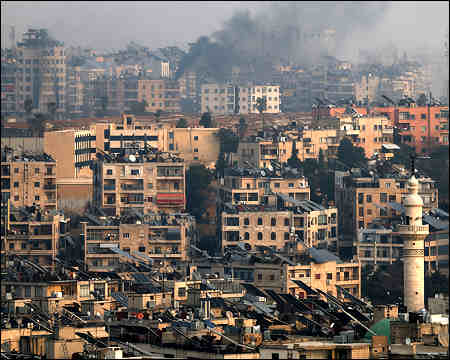
ALEPPO,— Kurdish-led forces said on Sunday they agreed to withdraw their Kurdish protection units from Aleppo under a ceasefire arrangement after several days of fighting with Syrian government Islamist militias, clashes that left civilian neighborhoods damaged and thousands of Kurds displaced.
The Syrian Democratic Forces SDF, said the truce followed intense military pressure by armed groups loyal to the interim Islamist-led government in Damascus, whose fighters pushed into Kurdish areas using heavy weapons and street-level raids.
Earlier on Sunday, Syria’s military announced it had completed what it described as security operations in the Kurdish Sheikh Maqsud neighborhood.
State media reported that Kurdish fighters who laid down their weapons were transported by bus toward northern Syria. The military had already declared control over Ashrafiyeh, Aleppo’s other Kurdish district.
For years, Kurdish forces maintained limited control inside Aleppo while running a autonomous administration region across Syrian Kurdistan, also known as Rojava Kurdistan, in the north and northeast.
That system emerged during the 14-year civil war and survived successive shifts in power until recent efforts by Syria’s new Islamist authorities to impose centralized rule by force.
The fighting erupted after talks to integrate Kurdish forces into the new state structure collapsed. Kurdish leaders accused Damascus of abandoning negotiations and resorting to military action instead of political solutions.
“We reached an understanding that led to a ceasefire and secured the evacuation of the martyrs, the wounded, trapped civilians, and fighters from Ashrafiyeh and Sheikh Maqsud to northern and eastern Syria,” the SDF said in a statement.
State news agency SANA said buses carrying what it called the final group of Kurdish fighters departed Sheikh Maqsud toward northeastern Syria.
Kurdish officials disputed that description, saying many of those transported were civilians forcibly displaced under military supervision.
According to the SDF, the ceasefire was achieved through mediation by international parties aiming to stop what it described as systematic attacks and violations against Kurdish residents in Aleppo.
The United States and the European Union separately urged the Syrian interim Islamist government and Kurdish representatives to return to political dialogue, warning that continued military escalation would further destabilize the country.
The clashes were among the most serious since the removal of former President Bashar al-Assad in December 2024.
At least 21 civilians were killed, according to figures released by both sides. Aleppo’s governor said about 155,000 residents, most of them Kurds, fled their homes as Islamist militias advanced through residential areas.
Both parties accused the other of initiating the fighting on Tuesday.
On the outskirts of Sheikh Maqsud, families emerged from besieged streets under escort by Syrian security forces. Witnesses reported that men carried children through debris-strewn roads before boarding buses bound for temporary shelters.
Dozens of young Kurdish men dressed in civilian clothing were separated from evacuees. Syrian security forces ordered them to sit on the ground before taking them away to undisclosed locations, according to reporters on the scene.
A Syrian security official, speaking on condition of anonymity, said the men were suspected fighters and were transferred to government detention centers. Kurdish officials described the detentions as arbitrary and politically motivated.
Some residents attempted to return home as fighting subsided. Sixty-year-old Imad al-Ahmad said he fled four days earlier and was unsure whether authorities would allow him back.
“I took shelter at my sister’s house,” he said. “I do not know if returning will be permitted.”
Nahed Mohammad Qassab, a widow waiting near a checkpoint, said her three children were still trapped inside the neighborhood after she left to attend a funeral before the clashes began.
“I want to get them out,” she said.
Flights at Aleppo airport remained suspended until further notice.
On Saturday, U.S. envoy Tom Barrack met interim President Ahmed al-Sharaa, also known as Golani, and called for renewed dialogue with Kurdish leaders under an integration framework agreed in March.
That agreement stalled after Damascus rejected Kurdish demands for decentralized governance.
The violence raised fears of broader regional involvement. Turkey, a close ally of Syria’s Islamist authorities, said it was prepared to intervene, while Israel openly supported Kurdish forces.
The events also cast doubt on the interim government’s claims of protecting minorities and reuniting Syria, following sectarian violence last year targeting Alawite and Druze communities.
Established in 2018, the Autonomous Administration in Rojava Kurdistan, oversees the region using a framework called democratic confederalism.
The system focuses on grassroots democracy, gender equality, secular governance, and environmental responsibility. It is often cited for increasing women’s involvement in political institutions and community-level decision-making.
(With files from AFP | Agencies)
Copyright © 2026 iKurd.net. All rights reserved.
Related posts:
 Sabotaging Syria
 Syrian government militias shell Kurdish areas in Aleppo after civilians flee
 Kurdish fighters refuse to pull out of Syria’s Aleppo after truce
 Business with ISIS – Updated
 The Resurrection (Ba’ath) Party – Before the Iran-Iraq War
 Syria bombs Kurdish neighborhoods in Aleppo city
 Damascus announces Aleppo ceasefire after clashes with Kurds
 Damascus, Kurdish SDF agree to de-escalate after Aleppo clashes
 Syria: Revisiting The Caesar Torture Victim Photographs
 Turkey: Nato’s Islamic State Member