

ALEPPO,— Syrian government-aligned Islamist militias shelled Kurdish-majority neighborhoods in the northern city of Aleppo on Wednesday after a deadline for residents to leave the areas expired, according to an AFP correspondent on the ground.
The shelling marked the second day of armed clashes between Damascus Islamists militias and Kurdish-led forces in the city.
The fighting erupted on Tuesday amid continued disagreement between Syria’s Islamist-led administration and Kurdish forces over a political and military integration agreement signed in March.
The deal was intended to merge the Kurdish autonomous administration and its armed units into Syria’s new governing structure, but implementation has stalled, with both sides accusing the other of violating its terms.
The Syrian militias announced that the Sheikh Maqsud and Ashrafiyeh neighborhoods had been designated closed military zones starting at 3 p.m. local time. Authorities said two humanitarian crossings were opened to allow civilians to leave safely before military operations began.
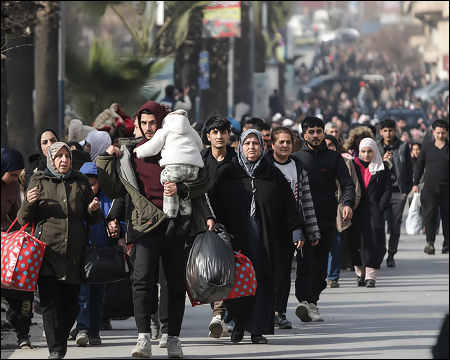
Thousands of residents fled the Kurdish neighborhoods ahead of the deadline. Many families were seen carrying bags, blankets, and personal belongings, while children walked alongside adults.
Some residents appeared visibly distressed as they departed areas that have remained under Kurdish control for years.
Ahmed, a 38 year old resident who declined to give his full name, said he left with his family to escape the fighting. Carrying his young son, said that years of conflict had left civilians exhausted. He said he did not know where his family would go next.
Another displaced resident, Ammar Raji, 41, said his family had no choice but to leave. He said he has six children, including two very young ones, and feared they might not be able to return to their home.
Raji said he had previously fled fighting in his hometown of Manbij six years earlier.
In a statement, Syrian government militias referring to themselves as the “Syrian army” said that all positions held by the Syrian Democratic Forces inside Sheikh Maqsud and Ashrafiyeh were considered legitimate military targets.
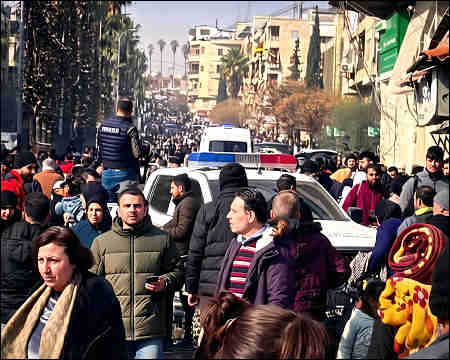
The SDF is a Kurdish-led force, the de facto army of the autonomous Kurdish administration in Syrian Kurdistan (Rojava), controls large parts of northern and northeastern Syria.
Kurdish officials strongly criticized the military action. Ilham Ahmed, a senior Kurdish political figure, accused Damascus of waging what she described as a genocidal campaign against Kurdish communities.
She called on Syrian authorities to pursue dialogue and political negotiations instead of military confrontation.
According to observers, claims by Syrian government militias that Kurdish forces initiated the attacks are untrue. The observers said the violence did not begin with Kurdish actions, citing documented events in 2025 in which fighters loyal to Sharra killed thousands of Alawite and Druze civilians during military operations.
The March 2025 agreement between Damascus and the Kurdish administration was supposed to be finalized by the end of 2025, according to officials familiar with the deal.
Kurdish leaders have continued to press for a decentralized system of governance, while Syria’s new Islamist leadership has rejected such proposals.
Sheikh Maqsud and Ashrafiyeh have remained under Kurdish security control despite an earlier agreement that Kurdish fighters would withdraw from the neighborhoods in April.
Kurdish security forces said in a statement that they repelled an attempted military advance involving tanks shortly after the evacuation deadline expired.
The same statement accused government-aligned forces of shelling residential areas using artillery and armored vehicles. Syrian authorities, in turn, accused the SDF of firing shells into areas under government control, an allegation Kurdish officials denied.
Authorities also announced the suspension of flights at Aleppo International Airport due to the security situation. Schools, universities, and government offices across the city were ordered closed.
Residents in other parts of Aleppo said the violence raised fears of renewed urban warfare. Joud Serjian, a 53 year old resident of the government-controlled Syriac Quarter, said the sound of shelling brought back memories of earlier phases of the war. She said her family planned to stay inside their home, adding that leaving was not an option.
The SDF controls wide areas of Syria with support from a US-led coalition and played a central role in the defeat of the Islamic State group in Syria in 2019.
Abdul Karim Omar, a representative of the Kurdish autonomous administration in Damascus, told AFP that the Kurdish neighborhoods in Aleppo were fully besieged. He denied claims that Kurdish forces had fired heavy weapons, saying their units in the area possess only light arms.
Aleppo was a major battleground during the Syrian civil war before former president Bashar al-Assad regained control of the city in 2016. Assad was later removed from power during an Islamist-led offensive in 2024.
The Autonomous Administration in Rojava Kurdistan, created in 2018, governs Kurdish-held regions under a political system based on democratic confederalism. The model emphasizes local decision-making, secular governance, gender equality, and environmental responsibility, and has increased women’s participation in political and administrative roles.
(With files from AFP | Agencies)
Copyright © 2026 iKurd.net. All rights reserved.
Related posts:
 Sabotaging Syria
 Kurdish fighters refuse to pull out of Syria’s Aleppo after truce
 The Resurrection (Ba’ath) Party – Before the Iran-Iraq War
 Syria bombs Kurdish neighborhoods in Aleppo city
 Business with ISIS – Updated
 Kurdish fighters agree to leave Syria’s Aleppo after deadly clashes
 Damascus, Kurdish SDF agree to de-escalate after Aleppo clashes
 Damascus announces Aleppo ceasefire after clashes with Kurds
 Syria’s Sharra symbolically declares Kurdish a “national language”, seen as “political game”
 Syria: A ‘Caliphate’ by Any Other Name — Would Smell the Same