


ALEPPO,— Syrian government-backed Islamist militias intensified bombardments of Kurdish neighborhoods in Aleppo on Thursday, forcing thousands of civilian Kurds to flee for safety.
This marks the third consecutive day of heavy fighting in the city, amid a stalled agreement to integrate Syria’s Kurdish administration in Syrian Kurdistan (Rojava) into the central government.
The renewed attacks, widely condemned by international observers, are the most severe in Aleppo since Islamist factions assumed effective control of Syria’s government.
Analysts said the fighting exposes the persistent fragility of the March 2025 deal to bring the US-backed, Kurdish-led Syrian Democratic Forces, or SDF, into a formal state role.
“We’ve gone through very difficult times. My children were terrified,” said Rana Issa, 43, who fled the Ashrafiyeh neighborhood under sniper fire. “Many people want to leave, but they are afraid of the shooters,” she told AFP.
The violence began Tuesday when clashes erupted between Syrian government Islamist forces and Kurdish fighters in Aleppo’s Sheikh Maqsud and Ashrafiyeh neighborhoods.
By Thursday, at least 17 people had been reported killed, according to local monitoring groups. Thousands of residents were displaced, seeking safety in surrounding areas.
The Syrian state news agency SANA, citing a military source, said government forces carried out “intense and concentrated bombardment towards SDF positions” in the two districts.
Civilians were evacuated through designated corridors while soldiers checked men in the neighborhoods. Aleppo airport remains closed, and schools, universities, and shops have been shuttered for two days, AFP correspondents reported.
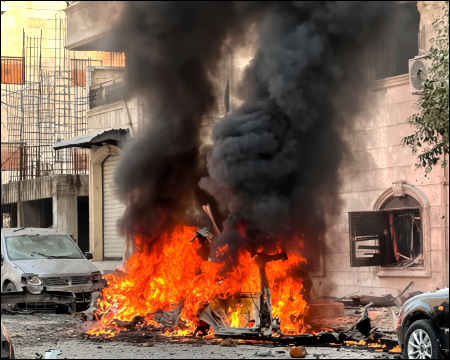
The Sharaa Islamist militias offensive resumed after a government deadline for civilians to evacuate expired. The army also released maps showing areas it claimed Kurdish forces were using to shell other parts of Aleppo.
The European Union expressed “great concern” over the violence, calling on “all sides to exercise restraint, protect civilians, and pursue a peaceful and diplomatic resolution.” EU officials are scheduled to visit Syria on Friday.
The conflict also reflects regional power struggles. Turkey, a key backer of Syria’s new Islamist-led authorities, has repeatedly pressured Kurdish forces and supports Damascus in its offensive.
A Turkish defense ministry official said that Turkey “supports Syria’s fight against terrorist organizations” and would provide assistance if requested.
Turkish Foreign Minister Hakan Fidan said Ankara has been in “intensive consultations” with Damascus and Washington to break the deadlock, blaming the SDF’s “uncompromising stance” for the stalled integration.
Turkey has launched multiple military operations in Syria’s Kurdish region, occupying large parts of it, including the Kurdish Afrin region along its 900-kilometer border, to push Kurdish fighters away from the frontier.
Israel has taken a contrasting position. Foreign Minister Gideon Saar condemned the attacks on Kurdish areas as “grave and dangerous,” warning that international inaction could worsen the situation.
Israel and Syria are negotiating a security agreement, including intelligence sharing, amid longstanding tensions over Syria’s treatment of minority groups.
The US-backed SDF controls much of northern and northeastern Syria, including key oil-producing areas.
The group was central to defeating the Islamic State in Syria in 2019. The March 2025 agreement with Damascus was meant to formalize SDF integration by the end of last year, but Kurdish demands for decentralization have blocked progress.
The Kurdish neighborhoods of Sheikh Maqsud and Ashrafiyeh remain under Kurdish control despite an earlier agreement for fighters to withdraw.
Experts warn Aleppo is the SDF’s most vulnerable urban area. Aron Lund, a fellow at the Century International research center, told AFP that “without a temporary deal, the situation risks escalating into a larger conflict.”
He added that a full-scale Damascus-SDF war, potentially drawing in Turkey and Israel, “could destabilize Syria completely.”
In 2025, Syrian government Islamist militias launched operations targeting minorities, including Alawites and Druze, killing thousands of civilians solely because they were not Muslim or because they demanded a decentralized Syria that would guarantee rights for all minorities.
UN Secretary-General Antonio Guterres called for immediate restraint and urged both sides to resume negotiations on the integration deal.
Meanwhile, in the main Kurdish city of Qamishlo in Syrian Kurdistan, hundreds of residents demonstrated against the violence in Aleppo. “We call on the international community to intervene,” said protester Salaheddine Cheikhmous, 61. Demonstrators carried banners reading “No to war” and “No to ethnic cleansing.”
The Autonomous Administration, officially established in 2018, manages the region according to the principles of democratic confederalism. Its governance model emphasizes direct democracy, gender equality, secularism, and environmental sustainability, and it has gained international recognition for promoting women’s participation in politics and local decision-making.
(With files from AFP | Agencies)
Copyright © 2026 iKurd.net. All rights reserved.
Related posts:
 Sabotaging Syria
 Syrian government militias shell Kurdish areas in Aleppo after civilians flee
 Kurdish fighters refuse to pull out of Syria’s Aleppo after truce
 Business with ISIS – Updated
 Damascus, Kurdish SDF agree to de-escalate after Aleppo clashes
 Kurdish fighters agree to leave Syria’s Aleppo after deadly clashes
 The SDF–Syrian Regime Agreement: Context, Gains, and Ongoing Risks
 Damascus announces Aleppo ceasefire after clashes with Kurds
 Syria’s Sharra symbolically declares Kurdish a “national language”, seen as “political game”
 Syria’s Kurds Should Seek a More Trusted Ally Than Trump’s U.S.