

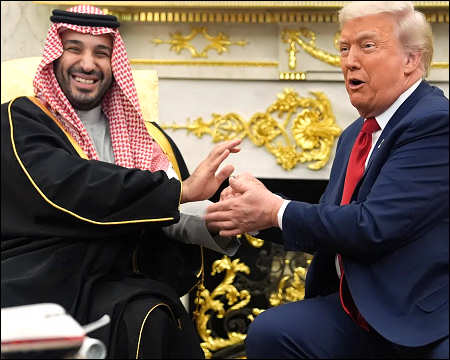
WASHINGTON,— U.S. President Donald Trump said Thursday that a civilian nuclear cooperation deal with Saudi Arabia will only move forward if the kingdom agrees to normalize relations with Israel, something Riyadh has repeatedly declined to do.
Trump said the deal would only take effect if Saudi Arabia signs on to the Abraham Accords, the U.S.-brokered agreements under which several Arab nations have established formal ties with Israel.
Saudi Arabia has long said it will not join the accords unless there is a clear path toward Palestinian statehood.
White House press secretary Karoline Leavitt told reporters that Trump had discussed linking the nuclear deal to the Abraham Accords with Gulf and Arab leaders on several occasions. She said if Saudi Arabia does not join the accords, “the deal is off.”
The United States and Saudi Arabia announced the nuclear agreement on Wednesday. It would allow Riyadh to enrich uranium and build nuclear reactors using American technology, without the immediate inspection requirements that Washington has demanded from Iran.
In a post on Truth Social Thursday, Trump wrote that the civil nuclear deal, which he said includes no enrichment of material, applies only to non-military uses similar to those already granted to Iran and the United Arab Emirates.
He said any approval depends entirely on Saudi Arabia joining what he called the “very respected and successful” Abraham Accords.
Trump added that the United States does not object to civil, non-enriched nuclear facilities.
Under the terms described, Congress will have 90 legislative days to review the agreement before it can take effect.
A two-year feasibility study would also be conducted on the enrichment portion of the deal.
The Saudi Embassy in Washington did not respond to a request for comment on Trump’s remarks.
Before Trump tied the deal to the Abraham Accords, Saudi officials said the agreement supports efforts to diversify the kingdom’s energy sources and follows the highest international standards for nuclear safety, security and nonproliferation.
Leavitt said the administration will keep talking with Saudi officials to finalize the deal and said she hopes the kingdom will join the Abraham Accords soon.
She said she did not believe Trump had spoken directly with Crown Prince Mohammed bin Salman since posting his message, though the topic had come up in earlier discussions.
The United Arab Emirates and Bahrain became the first Arab nations in 25 years to recognize Israel when they signed the Abraham Accords in 2020, during Trump’s first term. Morocco and Sudan later joined as well.
Israel, which had expressed concern that the Saudi nuclear deal could spark a regional arms race, welcomed the new condition.
A statement from Israeli Prime Minister Benjamin Netanyahu’s office called Saudi Arabia’s potential entry into the accords a historic step toward peace in the Middle East.
Leavitt said she was not aware of any request from Netanyahu to attach the accords condition to the nuclear deal.
Officials said Wednesday that the agreement complies with the U.S. Atomic Energy Act’s nonproliferation rules, among the strictest in the world.
The deal would permit uranium enrichment and reprocessing of nuclear waste, both of which can lead toward weapons capability. The UAE agreed to avoid both when it signed a similar deal with Washington in 2009.
It remains unclear exactly what Trump meant by saying there would be no enrichment under the deal, or whether he was referring specifically to weapons-grade uranium, which is enriched to about 90%, compared with the up to 6% enrichment used for reactor fuel.
The International Atomic Energy Agency said it is waiting for a formal request from Washington and Riyadh before it can begin implementing verification measures and seeking approval from its board of governors.
(With files from Reuters)
Copyright © 2026 iKurd.net. All rights reserved.
Related posts:
 The Resurrection (Ba’ath) Party – Before the Iran-Iraq War
 Trump hosts Saudi crown prince Mohammed bin Salman at the White House
 This is how the Saudis deal with bullies
 If all emblems are correct? US & Iran tilting nuclear deal reach
 Trump orders Pentagon to restart US nuclear weapons testing
 Trump meets Sharra, vows to lift sanctions on Syria
 Saddam Hussein was a Friend to the West
 Iran no longer enriching uranium at any site, FM says
 UN reimposes Iran sanctions, including arms embargo
 Saudi Arabia, Pakistan sign defense pact after Israel strikes Qatar