

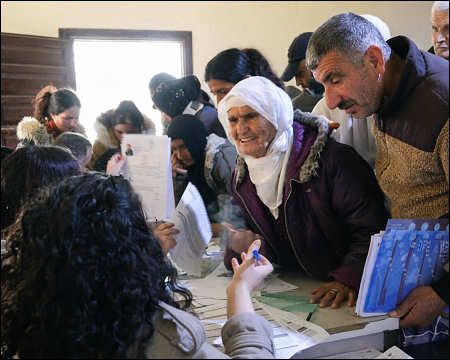
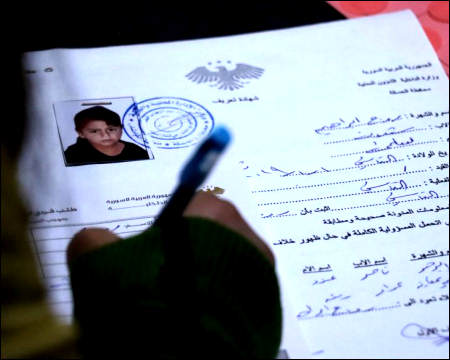
QAMISHLO,— A steady flow of Kurdish applicants filled a registration center set up inside a sports stadium hall in Qamishlo in Syrian Kurdistan (Rojava), where many gathered to seek Syrian citizenship after decades without legal recognition.
Among them was Firas Ahmad, who said the absence of citizenship had defined his family’s life. Holding papers and waiting in line, the 49-year-old described the limitations he faced.
“A person without citizenship is considered as good as dead,” he told AFP. He said he could not officially register his children or property. His grandfather also lived without citizenship, and the situation continued across generations.
Since last week, stateless Kurds have been arriving at centers across Syria following directions from the interior ministry. The new process allows individuals classified as “unregistered” to apply for citizenship.
Tables inside the hall were covered with forms, identification photos and older documents. Officials worked through long lines, recording details from applicants.
The policy follows a January decree issued by Islamist interim President Ahmed al-Sharaa, granting citizenship to Kurds residing in Syria, including those excluded for decades.
The decree also affirms Kurdish cultural rights and recognizes the Kurdish language at the national level.
The announcement came after fighting between Kurdish forces and Syrian government Islamist troops.
Kurdish groups had controlled large areas in the northeast before reaching an agreement to merge their administration into the state.
As part of that arrangement, government troops entered Hasaka and Qamishlo in February.
In March, Kurdish commander Sipan Hamo was named assistant defense minister for the eastern region.
For years, the lack of citizenship limited basic rights. Many Kurds were unable to register births, claim property ownership, travel freely, study or secure employment.
“We suffered greatly,” said Galya Kalash, a mother of five. Speaking in Kurdish, she said her children could not complete school and the family was unable to travel. Their home remains unregistered.
The issue dates back to a 1962 census in Hasaka province that stripped about one fifth of Syria’s Kurds of nationality. Syria’s Kurdish population is estimated at around two million, mainly in the northeast.
Ali Mussa, from the Network of Statelessness Victims in Hasaka, told AFP that about 150,000 people remain without registration. He urged authorities to apply the new rules with flexibility and consider the situation of those living abroad.
He said some refugees in Europe may face difficulties returning due to their legal status or concerns about travel disruptions linked to regional conflict.
Authorities said the registration period is expected to last one month, with the possibility of an extension.
Abdallah al-Abdallah, a government civil affairs official, said obtaining citizenship is the main form of redress for those affected after years without legal status.
At the center, Mohammed Ayo, 56, explained how the lack of citizenship affected his daily life. He said he could not obtain a driver’s license or reserve a hotel room in Damascus because of required approvals.
“You study for many years, and in the end they say you have no certificate,” he said. After completing high school, he was unable to obtain documents needed for university.
He added that stateless individuals were excluded from voting and running for public office.
Established in 2018, the Autonomous Administration in Syrian Kurdistan oversees the region based on a system of democratic confederalism.
The Rojava model focuses on direct public participation, gender equality, secular governance and environmental protection. It has gained recognition for encouraging women to take part in political roles and community-level decision-making.
(With files from AFP)
Copyright © 2026 iKurd.net. All rights reserved.
Related posts:
 The SDF–Damascus deal: A gamble over keys to Kurdish homeland
 Iraq considers law to ban dual nationals from senior government posts
 The Resurrection (Ba’ath) Party – Before the Iran-Iraq War
 The SDF–Syrian Regime Agreement: Context, Gains, and Ongoing Risks
 Sharaa’s forces enter Qamishlo under agreement with Syria’s Kurds
 The Syrian Al-Jazeera Province: An Ethnic, Social and Political Study – Book
 Syria: Revisiting The Caesar Torture Victim Photographs
 Business with ISIS – Updated
 Iraq: A State of Surveillance – Databases, Tracking And Corruption
 Syria’s Sharra symbolically declares Kurdish a “national language”, seen as “political game”