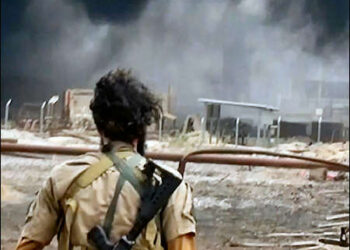


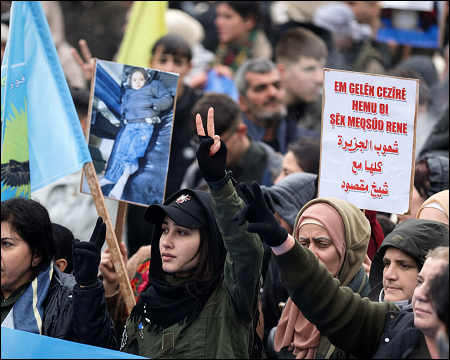
QAMISHLO,— Thousands of Kurdish residents gathered in the streets of the Kurdish city of Qamishlo on Tuesday as steady rain fell, protesting the removal of Kurdish armed groups from Aleppo following several days of fighting that forced a mass displacement of civilians.
The demonstration took place in Rojava Kurdistan, the Kurdish-administered region in northeast Syria, where anger has been growing over actions taken by Syria’s new Islamist-led authorities.
The clashes in Aleppo marked one of the most serious confrontations between Kurdish forces and the interim Islamist government headed by Ahmed al-Sharaa, also known as Abu Mohammed al-Golani, a former al-Qaeda figure who now claims authority over the country after more than a decade of war.
The fighting lasted nearly five days and resulted in significant casualties. Syria’s health ministry reported at least 23 deaths, while Kurdish officials placed the toll higher.
Ilham Ahmad, a senior Kurdish political figure, told journalists that government attacks killed at least 48 people. The violence also triggered the displacement of more than 150,000 residents, most of them Kurds, from the city’s two historically Kurdish neighborhoods.
Syrian government Islamist militias have been widely accused by human rights groups of committing systematic abuses against Kurdish civilians and fighters.
Protesters in Qamishlo carried flags and banners linked to Kurdish military forces, along with portraits of fighters killed during the battles. Some of those fighters, Kurdish officials said, carried out suicide attacks as government troops advanced into their areas.
Demonstrators also displayed placards showing images of interim President Ahmed al-Sharaa and Turkish Foreign Minister Hakan Fidan marked with red X symbols and labeled as responsible for violence against Kurdish civilians.
The last Kurdish fighters withdrew from Aleppo in the early hours of Jan. 11, ending more than a decade of limited Kurdish presence in parts of the city that had remained under their control since the Syrian conflict erupted in 2011.
Despite the withdrawal, Kurdish authorities continue to govern a semi-autonomous area across much of Rojava Kurdistan.
That administration has resisted pressure to dissolve itself and merge fully into the new central government in Damascus, which is dominated by Islamist factions that took power following the ouster of longtime president Bashar al-Assad in December 2024.
An agreement reached in March 2025 aimed at integrating Kurdish institutions into the central state has made no progress. Ahmad said Kurdish officials now view the deal as effectively void if Damascus continues military operations against Kurdish-held areas.
Political analysts and regional experts have raised serious doubts about the feasibility of integrating Rojava Kurdistan into Syria’s current Islamist system
They point out that Rojava operates under a democratic system, secular, decentralized model that guarantees full legal and political equality between women and men, encourages direct local governance, and emphasizes pluralism and environmental responsibility.
Kurds and other minority communities have not been included in talks related to Syria’s future political structure, including discussions on the constitution, interim governance, or parliamentary arrangements, according to Kurdish representatives and independent observers.
Turkey, which holds significant influence over decisions made by the authorities in Damascus, accuses the US-backed Syrian Democratic Forces SDF, the main Kurdish military alliance, of ties to the Kurdistan Workers’ Party, an organization Ankara classifies as “terrorist”. Kurdish leaders reject the accusation and say it is used to justify military pressure and displacement.
Several analysts have stated that Washington effectively allowed the Aleppo operation to proceed by withholding opposition to the advance of government Islamist forces into Kurdish areas in Aleppo.
The commander of U.S. forces in the Middle East issued a statement urging restraint. Admiral Brad Cooper, head of U.S. Central Command, said all parties should return to negotiations and seek a lasting political settlement through dialogue.
Concerns remain high among Kurdish residents that the Aleppo clashes could lead to broader conflict. Syria’s defense ministry announced that eastern districts of Aleppo remain a closed military zone and ordered Kurdish armed groups to withdraw further east.
Idris al-Khalil, a resident of Qamishlo who attended the protest, said recent events echoed earlier episodes of sectarian violence against minority communities, including Alawites on the coast and Druze populations in southern Syria.
Kurdish religious and civic leaders warned that continued military pressure would deepen divisions and undermine coexistence in Syria.
Hassan Muhammad, head of the Council of Religions and Beliefs in Northeast Syria, said Kurdish rights must be formally recognized in any future constitution if unity is to be achieved.
Experts question how such a modernized social and political structure could be absorbed into a radical Islamist government led by Sharaa, whose administration in Damascus has concentrated power in the hands of a narrow leadership circle.
Observers say laws are being issued by decree, without public consultation or representation from Kurds, Christians, Druze, Alawites, or other minority groups.
(With files from Reuters | Agencies)
Copyright © 2026 iKurd.net. All rights reserved.
Related posts:
 Sabotaging Syria
 Business with ISIS – Updated
 The Resurrection (Ba’ath) Party – Before the Iran-Iraq War
 Turkey: Nato’s Islamic State Member
 Syria: A ‘Caliphate’ by Any Other Name — Would Smell the Same
 Syria: Revisiting The Caesar Torture Victim Photographs
 The SDF–Syrian Regime Agreement: Context, Gains, and Ongoing Risks
 Sharaa’s forces enter Qamishlo under agreement with Syria’s Kurds
 Martyrs for Millionaires: The Black-Market Politics behind the Theft of Syria’s Oil
 The Mustashar and the Jash – A View from the Position of ‘Iraqi National Unity’ on the ‘Descendants of Treason’