

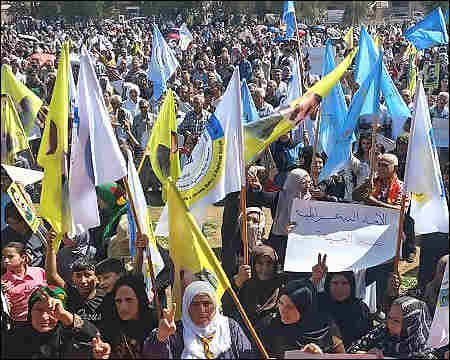
QAMISHLO, Syrian Kurdistan,— Thousands of people took to the streets across Syrian Kurdistan (Rojava) on Wednesday to back their autonomous administration and renew calls for a decentralized political system, as talks with Damascus over the region’s future remain stalled.
Crowds gathered in the main Kurdish city of Qamishlo, waving flags of the Autonomous Administration of North and East Syria and banners supporting the Syrian Democratic Forces, the Kurdish-led militia that serves as Rojava’s de facto army and is backed by the United States. Some demonstrators carried a sign that read, “The SDF is the will of the people.”
The protest comes months after Damascus and Kurdish representatives reached a framework agreement in March to integrate Syrian Kurdistan’s political and military institutions into the Syrian state.
Officials say progress has been blocked by disagreements over power sharing.
“The demand for decentralization is not only for the Kurdish region but for all of Syria,” senior Kurdish official Aldar Khalil told the rally. “If the Kurdish question is left unresolved, Syria will not become a democratic state and the crises will continue.”
Damascus has rejected Kurdish demands for local autonomy, insisting on a centralized system of governance. Multiple negotiating sessions since March have ended without major breakthroughs.
Kurdish leaders have also objected to a temporary constitutional declaration adopted by the Islamist-led authorities who replaced former president Bashar al-Assad earlier this year.
They argue the document fails to recognize Syria’s ethnic and religious diversity.
Tensions elsewhere in the country have added to Kurdish concerns. Violence in Sweida province, where most residents are Druze, left dozens dead in July, while mass killings of Alawites were reported in coastal regions in March.
Another point of contention has been the delayed selection of a new transitional parliament. Kurdish officials say the process has excluded areas under their control in the north and northeast, calling it undemocratic. Authorities have rescheduled the vote for later this month.
Syria’s interim president, Ahmed al-Sharaa, acknowledged last week that negotiations with Kurdish groups had slowed. He said his administration remained committed to avoiding armed confrontation.
Al-Sharaa, also known as Abu Mohammed al-Golani, has a past that includes involvement with al-Qaeda and ISIS before he went on to establish the al-Nusra Front. That group, once aligned with al-Qaeda, later rebranded itself as Hayat Tahrir al-Sham (HTS).
Formed in 2018, the Autonomous Administration governs through a model of democratic confederalism, stressing local democracy, secularism, gender equality and environmental priorities. The system has gained recognition for boosting women’s participation in politics and community leadership.
(With files from AFP)
Copyright © 2025 iKurd.net. All rights reserved
Related posts:
 The Resurrection (Ba’ath) Party – Before the Iran-Iraq War
 The SDF–Damascus deal: A gamble over keys to Kurdish homeland
 Business with ISIS – Updated
 Syria: The Hijacking of the Arab Spring: From ISIS to Hayat Tahrir al-Sham
 Syria: Revisiting The Caesar Torture Victim Photographs
 Kurds in Syrian Kurdistan want to preserve the cultural rights
 Sabotaging Syria
 Turkey: The Psychological War Against the Kurds Through the PKK – Part I
 Stealing Syria
 Turkey: Nato’s Islamic State Member